

What's Happening?
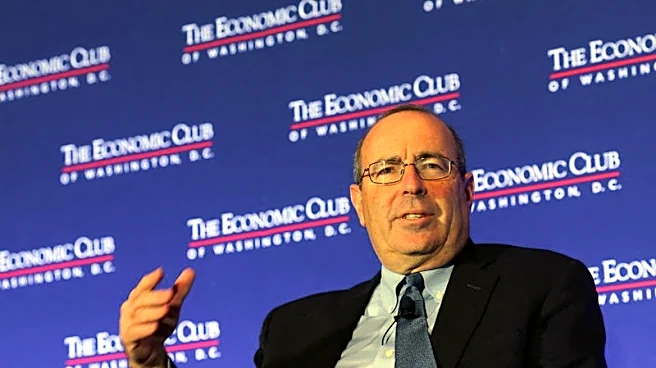
St. Louis Federal Reserve President Alberto Musalem has stated that there is no immediate need for the U.S. central bank to alter its current interest rate policy, despite rising inflation risks linked to the ongoing conflict in the Middle East. Speaking
at the American Enterprise Institute in Washington, Musalem emphasized that the Federal Reserve's policy is well-positioned to manage risks to its dual mandate objectives. He highlighted the uncertainty in the economic outlook, which includes potential impacts from the Middle East conflict and unsettled tariff policies that could affect consumer and business spending. Musalem noted that while the Federal Reserve typically views supply shocks as temporary drivers of inflation, the current situation might differ, warranting caution. The Federal Reserve has maintained its benchmark overnight interest rate in the 3.50%-3.75% range, awaiting further data on the conflict's impact on global supply chains and energy prices.
Why It's Important?
The Federal Reserve's stance on interest rates is crucial for the U.S. economy, particularly in times of geopolitical tension. The ongoing conflict in the Middle East has led to increased energy prices and disrupted supply chains, which could exacerbate inflationary pressures. Musalem's comments suggest that the Federal Reserve is carefully balancing the need to support economic growth while managing inflation risks. This approach is significant for businesses and consumers, as interest rate changes can influence borrowing costs, investment decisions, and overall economic activity. The Federal Reserve's cautious approach reflects the complexity of the current economic environment, where external shocks and domestic policy uncertainties intersect.
What's Next?
The Federal Reserve will continue to monitor economic indicators and geopolitical developments to determine the appropriate course of action for its monetary policy. Musalem indicated that future rate adjustments could be considered if there are significant changes in the labor market or inflation expectations. The central bank's decisions will likely be influenced by the evolving situation in the Middle East and its impact on global markets. Stakeholders, including businesses and policymakers, will be closely watching for any signals from the Federal Reserve regarding potential rate cuts or hikes, as these decisions will have far-reaching implications for the U.S. economy.