





What's Happening?
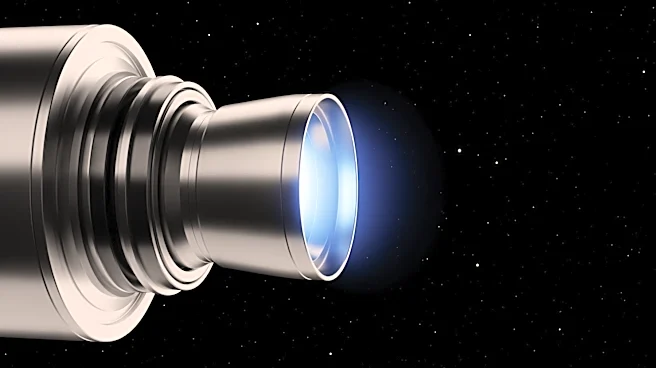
Rocket Lab has announced the addition of a high-performance Hall-effect satellite thruster, named Gauss, to its range of space technologies. This development was revealed at the 2026 Space Symposium in Colorado Springs. The Gauss thruster is designed
to provide a higher specific impulse compared to traditional chemical propulsion systems, making it more efficient for long-duration missions. Rocket Lab has established a production line capable of manufacturing up to 200 units of these electric thrusters annually. The thruster is powered by Xenon, with an option for Krypton, and is intended to support the growing demand for propulsion systems in proliferated satellite constellations. CEO Peter Beck emphasized the importance of scaling satellite components to meet market needs for volume and speed, highlighting the Gauss thruster's role in reducing propellant requirements while maintaining high performance.
Why It's Important?
The introduction of the Gauss thruster by Rocket Lab is significant for the satellite industry, particularly in the context of proliferated constellations used by commercial and national security space users. The thruster's high efficiency allows for reduced propellant usage, which is crucial for long-duration missions and satellite station-keeping. This innovation addresses a critical bottleneck in the availability of reliable propulsion systems at scale, potentially enhancing the operational capabilities of satellite constellations. The development aligns with the industry's shift towards more sustainable and efficient space technologies, offering a competitive edge to Rocket Lab in the growing market for satellite propulsion solutions.