








What's Happening?
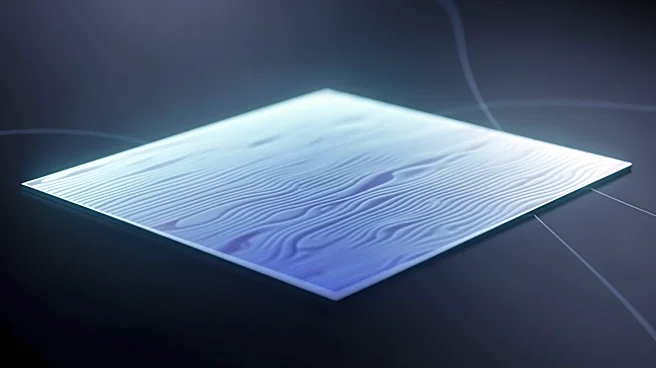
A team of international scientists has discovered a new mode of heat transport in ultrathin semiconductors, specifically in materials like molybdenum disulfide and molybdenum diselenide. This new regime, termed 'hydro-thermoelastic transport,' significantly
hinders thermal diffusion, challenging traditional models of heat conduction. The study reveals that heat carriers, known as phonons, exhibit fluid-like behaviors, leading to slower heat propagation. This discovery, published in Nature Physics, highlights the complex interactions between thermal and mechanical properties in these materials, offering new insights into nanoscale heat management.
Why It's Important?
This breakthrough has significant implications for the future of electronics and photonics, where managing heat dissipation is crucial for device performance and miniaturization. The ability to control heat flow at the nanoscale could lead to more efficient thermal management systems, enhancing the reliability and efficiency of next-generation devices. This discovery also opens up new possibilities for developing thermoelectric devices that convert waste heat into usable energy, contributing to more sustainable technology solutions.
What's Next?
The findings pave the way for further research into the thermal properties of two-dimensional materials, potentially leading to new applications in electronics and photonics. Scientists and engineers may explore ways to harness these unique thermal behaviors to design devices with improved energy efficiency and thermal stability. Additionally, this research could influence the development of new materials and technologies aimed at overcoming the challenges of heat management in increasingly miniaturized electronic components.