



What's Happening?
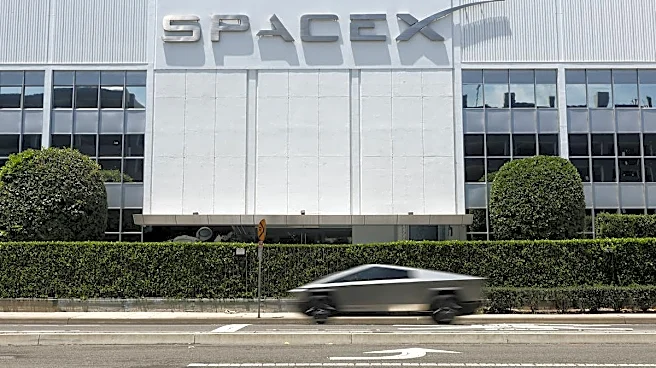
Elon Musk's company, SpaceX, is preparing for a highly anticipated initial public offering (IPO) that could potentially make Musk the world's first trillionaire. The IPO is set to value SpaceX at $1.77 trillion, making it one of the largest public offerings
in history. Wall Street is abuzz with excitement, with major banks like Goldman Sachs and JPMorgan heavily involved in the process. The IPO is expected to raise $74.4 billion, significantly boosting Musk's wealth, which is already estimated at $970 billion. SpaceX's IPO is being treated as a major cultural and financial event, with banks hosting elaborate presentations and events to attract investors. The company has set its IPO price at $135 per share without the usual investor consultations, reflecting confidence in strong demand.
Why It's Important?
The SpaceX IPO is significant not only for its size but also for its potential impact on the financial markets and the tech industry. If successful, it could set a new benchmark for public offerings and influence future IPOs, such as those of OpenAI and Anthropic. Musk's potential trillionaire status underscores the growing influence of tech entrepreneurs in global economics and politics. His wealth, largely tied to shares, highlights the increasing concentration of economic power in the hands of a few individuals. This development raises questions about the balance of power and the role of public oversight in the face of such immense private wealth. The IPO also reflects the high investor interest in space exploration and artificial intelligence, sectors that are seen as pivotal for future technological advancements.
What's Next?
Following the IPO, SpaceX is expected to be fast-tracked into major market indexes, compelling large equity funds to purchase its shares. This could further drive up the stock price and Musk's net worth. The success of the IPO will be closely watched as a barometer for investor confidence in high-tech ventures. Additionally, the IPO's outcome may influence the strategies of other tech companies considering going public. As SpaceX becomes a publicly traded company, it will face increased scrutiny from investors and regulators, particularly regarding its ambitious plans in space exploration and artificial intelligence. The company's performance post-IPO will be critical in determining its long-term valuation and impact on the market.
Beyond the Headlines
The rise of Elon Musk to potential trillionaire status raises broader ethical and societal questions. His influence extends beyond business, affecting geopolitical dynamics through ventures like Starlink, which provides internet services in conflict zones. The concentration of wealth and power in a single individual challenges traditional notions of economic equity and governance. As Musk's ventures continue to intersect with public interests, there will be ongoing debates about the need for regulatory frameworks to ensure accountability and transparency. The SpaceX IPO also highlights the speculative nature of modern financial markets, where investor decisions are often driven by fear of missing out (FOMO) rather than fundamental analysis.