





What's Happening?
Rheinmetall, a German defense contractor, in collaboration with the British Kraken Technology Group, has commenced the serial production of the Kraken K3 Scout unmanned naval surface vessels at the Blohm+Voss shipyard in Hamburg. This development marks
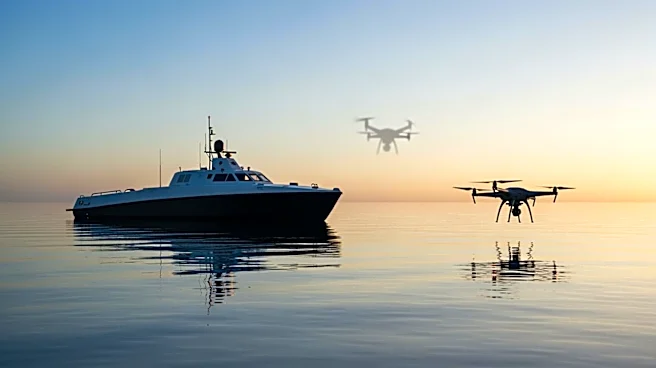
a significant step in enhancing capabilities in autonomous maritime systems. The Kraken K3 Scout is a high-speed, modular unmanned surface vessel (USV) designed for various applications, including maritime reconnaissance, infrastructure protection, and combat operations. The vessel can reach speeds of up to 55 knots and is approximately 8.4 meters long, allowing for customization based on specific operational needs. The production is managed by the Rheinmetall Kraken GmbH joint venture, which aims to produce around 200 units annually, with the potential to scale up to 1,000 units depending on demand.
Why It's Important?
The initiation of serial production of the Kraken K3 Scout represents a significant advancement in the field of unmanned maritime technology. This development could have substantial implications for both military and civilian sectors, offering enhanced capabilities for maritime security and operational efficiency. The ability to produce these vessels at scale addresses the growing demand for autonomous systems in maritime operations, potentially transforming how naval and civilian maritime tasks are conducted. The collaboration between Rheinmetall and Kraken Technology Group highlights the increasing importance of international partnerships in advancing technological capabilities and meeting global security needs.
What's Next?
As production ramps up, the focus will likely shift to fulfilling initial orders and expanding the operational deployment of the Kraken K3 Scout. The joint venture may explore additional partnerships and markets to further enhance the vessel's applications and reach. Stakeholders in the defense and maritime industries will be closely monitoring the performance and adaptability of these vessels in real-world scenarios. The success of this venture could lead to further innovations in unmanned maritime technology and potentially influence future naval procurement strategies.