









What's Happening?
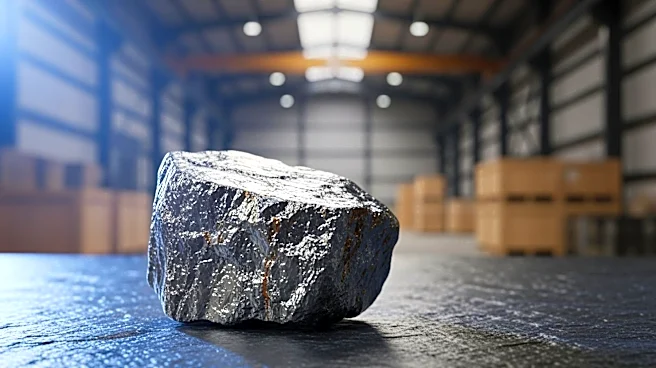
Recent reports indicate a significant increase in U.S. tungsten scrap exports to Japan, driven by Chinese restrictions on the material. This surge is part of a broader trend where Chinese buyers are aggressively seeking tungsten scrap across North America,
intensifying competition for secondary supply. Tungsten, once considered a specialty metal, is now recognized as a strategic material essential for aerospace, defense, semiconductor manufacturing, and industrial tooling. The restrictions are reshaping industrial planning globally, with Western governments accelerating efforts to diversify upstream supply chains. Despite these efforts, China continues to dominate downstream manufacturing and technology production, capturing significant value. The U.S.-China Business Council has reported that some critical minerals sourced from China remain nearly unobtainable, prompting companies to seek alternative sources.
Why It's Important?
The developments underscore the strategic importance of tungsten and other critical minerals in global supply chains. The U.S. and its allies are increasingly recognizing the need for supply-chain resilience, which requires not only access to raw materials but also industrial capacity. The shift from viewing critical minerals as mere commodities to instruments of industrial policy is evident. This has led to legislative actions in the U.S., such as the introduction of the Magnets Value Chain Support Act of 2026, aimed at encouraging domestic magnet manufacturing. The situation highlights the interconnectedness of industrial economies and the potential for supply disruptions to impact sectors like automotive, electronics, aerospace, and defense.
What's Next?
As the U.S. and other nations work to reduce dependence on Chinese processing capacity, initiatives such as Japan's establishment of a new rare earth refinery and the European Union's supply-chain diversification requirements are expected to gain momentum. These efforts aim to embed supply-chain resilience into industrial regulation. The U.S. is likely to continue promoting domestic manufacturing capabilities, while countries like Brazil emerge as alternative sources of supply. The focus on control over critical mineral supply chains is becoming a matter of national competitiveness, with different governments pursuing various strategies to achieve this goal.
Beyond the Headlines
The strategic importance of critical minerals extends beyond immediate supply concerns. The focus on processing technology and industrial capacity highlights a shift in policy frameworks and trade relationships. The emphasis on national security considerations is reshaping the critical minerals sector, with implications for economic resilience. The evolving landscape suggests that future demand growth may be distributed across a broader range of critical minerals, with implications for investors and policymakers alike.