


What's Happening?
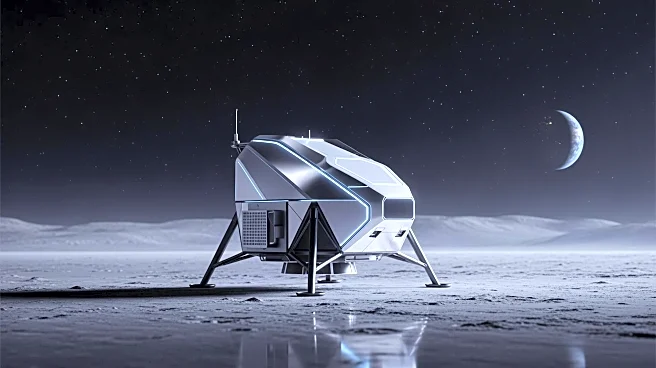
NASA has announced significant changes to its Artemis Moon landing program, introducing a preparatory step to test commercial landers in Earth's orbit in 2027, a year before the planned crewed missions to the lunar surface in 2028. This adjustment aims
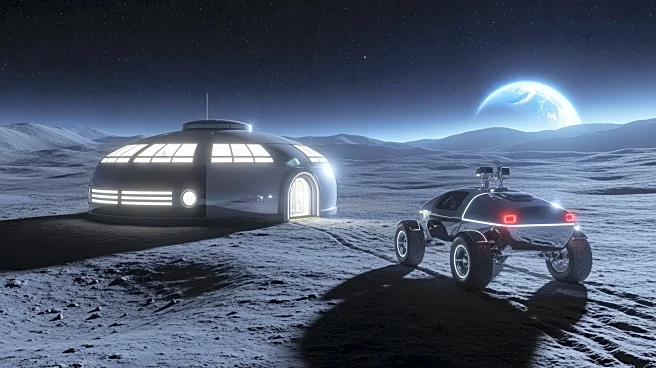
to mitigate risks following recent delays and safety concerns. Concurrently, PwC's Lunar Market Assessment projects that the Moon economy could generate $127.3 billion in revenue by 2050. The report emphasizes the importance of developing alternative energy infrastructures, such as solar energy systems, to support long-term lunar activities. However, experts like Mihails Ščepanskis, CEO of Deep Space Energy, caution that solar power alone may not suffice for sustained operations on the Moon, especially during the 14-day lunar night when solar panels are ineffective.
Why It's Important?
The development of a Moon economy represents a significant opportunity for economic growth and technological advancement. The projected $127 billion market could drive innovation in energy solutions, space exploration, and resource utilization. However, the success of this economy hinges on overcoming substantial challenges, particularly in energy infrastructure. The reliance on solar power is problematic due to the Moon's long nights and extreme temperatures, necessitating alternative energy solutions like nuclear power. The U.S. and other major powers are investing in nuclear energy for lunar operations, with NASA and the U.S. Department of Energy planning a lunar surface fission reactor by 2030. These developments could position the U.S. as a leader in space exploration and energy technology.
What's Next?
As NASA and other stakeholders continue to refine their lunar strategies, the focus will likely shift towards developing reliable, non-solar energy systems to support both stationary and mobile lunar operations. The U.S. commitment to a lunar fission reactor by 2030 is a step in this direction, but further advancements in compact, mobile power systems are necessary. Companies like Deep Space Energy are exploring radioisotope-based power systems to address these needs. The success of these initiatives will depend on overcoming technical and material challenges, such as the limited availability of space-grade radioisotope fuel. The outcome of these efforts will shape the future of lunar exploration and the broader Moon economy.
Beyond the Headlines
The push for a Moon economy raises ethical and environmental considerations, such as the impact of nuclear energy on the lunar environment and the sustainability of resource extraction. The development of a lunar economy also poses geopolitical challenges, as countries vie for dominance in space exploration and resource utilization. The establishment of international regulations and cooperation will be crucial to ensure that lunar activities are conducted responsibly and equitably. Additionally, the technological advancements driven by lunar exploration could have far-reaching implications for energy and resource management on Earth, potentially leading to new solutions for global challenges.