



What's Happening?
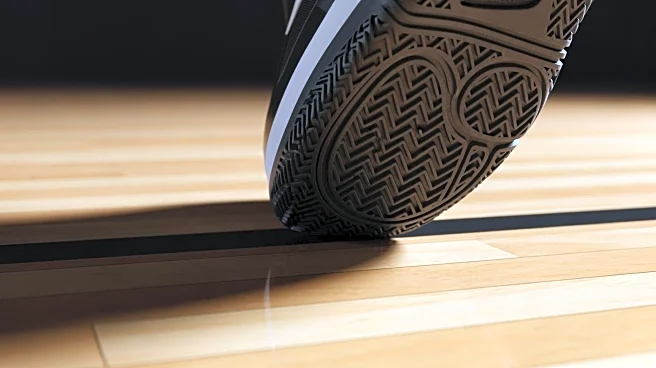
Adel Djellouli, a materials scientist at Harvard University, has conducted a study to understand the common squeaking sound produced by basketball sneakers on hardwood floors. Inspired by the persistent noise during a Boston Celtics game, Djellouli and his
team used a high-speed camera and microphone to analyze the interaction between sneaker soles and a smooth glass plate. Their research, published in the journal Nature, revealed that the squeaking noise is caused by tiny sections of the shoe sole changing shape as they lose and regain contact with the floor at high frequencies. This phenomenon creates ripples or wrinkles in the sole, which produce the characteristic squeak. The study also found that the grip patterns on the soles contribute to the sound, as featureless rubber did not produce the same effect.
Why It's Important?
This research provides valuable insights into the physics of friction, a complex and longstanding problem in science. Understanding the mechanics behind the squeaking sound could have broader applications beyond basketball. For instance, it could aid in the study of tectonic plate movements during earthquakes or help reduce energy consumption by minimizing friction and wear in various industries. Additionally, the findings could lead to the development of squeak-free shoes, addressing a common annoyance in quiet environments like offices. By potentially designing shoes that either enhance or eliminate the squeak, manufacturers could cater to different consumer preferences.
What's Next?
The study opens the door for further research into designing shoe soles that can control the pitch of the squeak or eliminate it altogether. Future experiments might explore how altering the thickness of the rubber affects the sound, potentially leading to shoes that produce inaudible squeaks. This could revolutionize shoe design, offering new products that cater to specific needs, such as quieter footwear for professional settings. Researchers may also investigate other materials and designs to optimize friction control in various applications, from sports to industrial machinery.