








What's Happening?
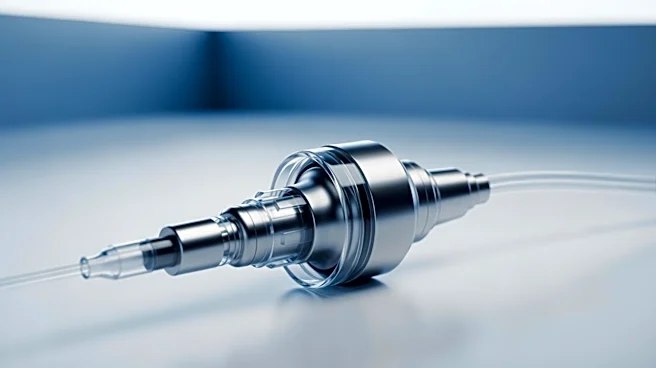
Johnson & Johnson has introduced a new version of its Shockwave coronary intravascular lithotripsy catheter, named Shockwave C2 Aero. This fifth-generation device is designed to assist physicians in treating complex calcified lesions and restoring blood
flow in arteries more effectively. The catheter is currently available in the U.S. and Japan, with plans for its introduction in Europe and Canada in the coming months. The Shockwave C2 Aero aims to provide greater flexibility and ease of repositioning during procedures, addressing unmet needs in complex percutaneous coronary intervention (PCI) procedures. The technology uses ultrasonic acoustic pressure waves to break down hardened calcium in blocked arteries, facilitating blood flow restoration. Johnson & Johnson's acquisition of Shockwave Medical for $13.1 billion in May 2024 has positioned the company as a leader in the intravascular lithotripsy (IVL) market, with competitors like Stryker, Boston Scientific, and Abbott also seeking entry.
Why It's Important?
The launch of the Shockwave C2 Aero catheter is significant for the medical device industry and healthcare providers, as it enhances the treatment options for patients with complex coronary artery disease. By improving the deliverability and repositioning capabilities of the catheter, Johnson & Johnson is addressing critical challenges faced by physicians during PCI procedures. This advancement could lead to better patient outcomes, particularly for those with multivessel disease and complex calcification patterns. The Shockwave business has been a major growth driver for Johnson & Johnson, with sales reaching $305 million in the first quarter, marking an 18.5% increase year over year. The introduction of this improved catheter could further strengthen the company's position in the IVL market and drive future sales growth.
What's Next?
As Johnson & Johnson rolls out the Shockwave C2 Aero catheter in additional markets, the company is likely to focus on expanding its market share and maintaining its leadership position in the IVL sector. The introduction of this advanced technology may prompt competitors to accelerate their own product development efforts to capture a share of the growing market. Additionally, healthcare providers may begin to adopt the new catheter more widely, potentially leading to changes in standard treatment protocols for complex coronary artery disease. The success of this product could also influence future innovations in the field of intravascular lithotripsy and related medical technologies.