






What's Happening?
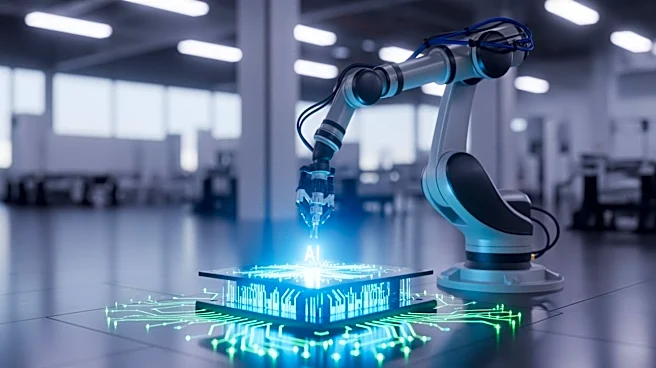
Flex and Teradyne Robotics have announced an expansion of their long-standing partnership to accelerate the deployment of physical AI and intelligent robotics across the manufacturing sector. This collaboration aims to standardize automation on a global
scale, with Flex serving as both a manufacturer of Teradyne’s core robotics components and a primary testing ground. The partnership involves deploying collaborative robots and autonomous mobile robots (AMRs) from Teradyne units Universal Robots (UR) and Mobile Industrial Robot (MiR) across Flex's production facilities worldwide. This strategic move is intended to drive operational efficiency and address the 'scale problem' that has hindered the widespread adoption of intelligent automation. The companies plan to solve power, heat, and scale challenges through advanced power and cooling technology, as well as scalable IT infrastructure.
Why It's Important?
The expansion of the partnership between Flex and Teradyne is significant for the broader industrial sector as it serves as a test case for integrating advanced manufacturing with AI-driven robotics. This collaboration could bridge the gap between experimental automation and global operational consistency, potentially setting a new standard for manufacturing efficiency. By leveraging Flex's global manufacturing capabilities and Teradyne's robotics technologies, the partnership aims to enhance productivity, flexibility, and operational resilience across various manufacturing environments. This development is crucial for industries such as electronics, industrial equipment, and data center infrastructure, which require increasingly complex manufacturing solutions.
What's Next?
As Flex and Teradyne continue to expand their partnership, the focus will likely be on validating robotics technologies at scale and enabling faster replication of successful automation workflows. The companies will work on addressing the rising complexity and scale requirements of modern factories, aiming to provide more adaptive and flexible systems. This could lead to further advancements in intelligent automation and potentially influence other companies in the manufacturing sector to adopt similar strategies. The partnership's success could also encourage more collaborations between technology providers and manufacturers to enhance global manufacturing capabilities.