



What's Happening?
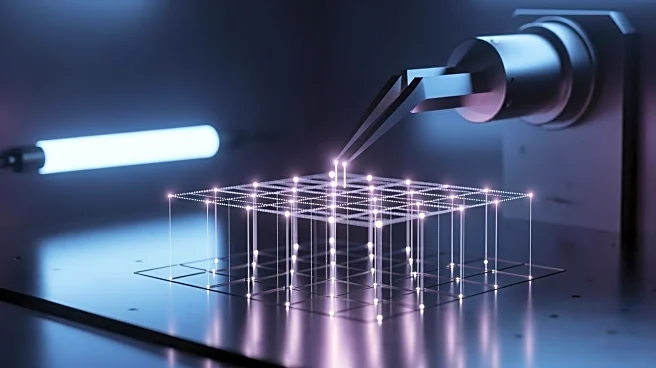
Researchers have developed an optical tweezer array capable of trapping 6,100 highly coherent atomic qubits, achieving a record imaging survival rate of 99.98952% and a coherence time of 12.6 seconds. This advancement marks a significant leap in quantum computing, as it suggests the feasibility of universal quantum computing and quantum error correction with thousands of qubits. The array consists of nearly 12,000 potential trapping sites and utilizes far-off-resonant wavelengths to minimize atom loss, allowing for room-temperature trapping for approximately 23 minutes. This system's high fidelity and stability are crucial for quantum simulation, metrology, and the development of larger, more robust quantum systems.
Why It's Important?
The development of a 6,100
qubit optical tweezer array represents a major milestone in the field of quantum computing. The high imaging survival and fidelity rates are essential for accurately reading the state of each qubit, minimizing errors, and supporting scalable quantum computing and error correction strategies. This breakthrough could accelerate the realization of practical quantum technologies, which have the potential to revolutionize industries by solving complex problems beyond the capabilities of classical computers. The ability to maintain coherence and control over thousands of qubits is a critical step towards building universal quantum computers, which could impact fields such as cryptography, materials science, and artificial intelligence.
What's Next?
The next steps involve further refining the optical tweezer array technology to enhance its scalability and reliability. Researchers will likely focus on improving the coherence time and fidelity of the system to support more complex quantum operations. Additionally, the development of a zone-based architecture for quantum computing, as proposed by the researchers, could facilitate the connection of computational zones and the implementation of complex quantum algorithms. These advancements will be crucial for overcoming the scalability challenges associated with quantum error correction and for realizing the full potential of quantum computing.