




What's Happening?
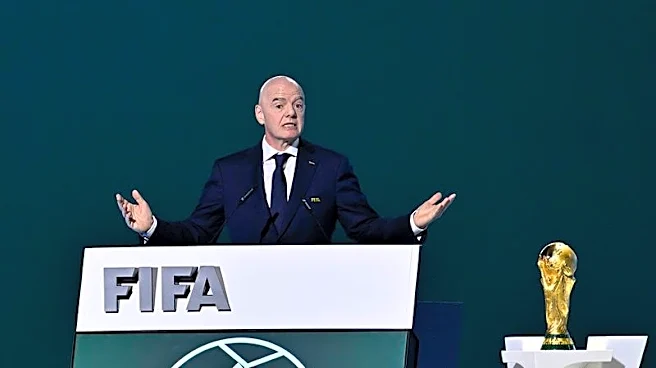
FIFA President Gianni Infantino announced that Iran will participate in the upcoming World Cup in the United States, despite protests calling for the team's ban. The announcement was made during the FIFA Congress in Vancouver, where Iranian delegates
were notably absent after being denied entry into Canada. Protesters outside the congress argued that Iran's team represents the Islamic Revolutionary Guard Corps (IRGC) rather than the Iranian people, and called for FIFA to ban the team. The protests are part of a broader reaction to Iran's internal political situation, including a crackdown on anti-government protests earlier this year.
Why It's Important?
The decision to allow Iran to participate in the World Cup highlights the complex intersection of sports and international politics. FIFA's stance reflects its commitment to inclusivity and unity in sports, despite political tensions. The protests underscore the ongoing global scrutiny of Iran's political actions and human rights record. This situation also places FIFA in a challenging position, balancing its role as a sports governing body with the political implications of its decisions. The outcome could influence future policies regarding the participation of countries with contentious political situations in international sports events.
What's Next?
FIFA's decision may lead to further protests and diplomatic discussions, particularly from countries and groups opposed to Iran's political regime. The situation could also prompt FIFA to review its policies on the participation of teams from politically sensitive regions. Additionally, the Iranian team's participation in the World Cup will likely be closely monitored by international observers, potentially affecting the atmosphere and security measures at the event.