





What's Happening?
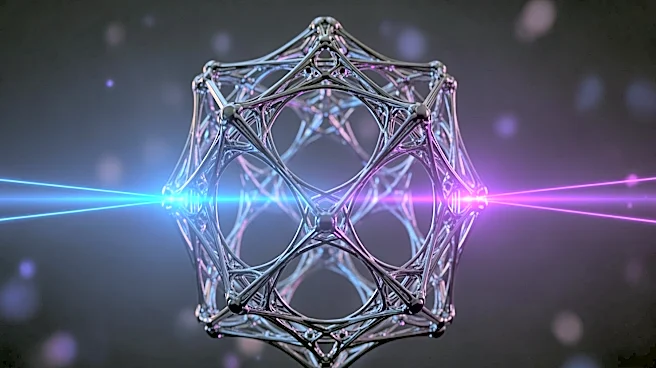
A collaborative team of researchers from Sweden, Germany, Luxembourg, and China has observed new three-dimensional magnetic structures known as hopfions using femtosecond laser light. Published in Nature Physics, the study reveals that these structures,
which involve complex spin arrangements, were observed in thin films of iron germanium. Hopfions are stable, three-dimensional objects formed by electron spins that create closed and linked loops. The discovery was made possible by using femtosecond laser pulses to disturb the spin system, allowing new magnetic states to form. This breakthrough provides a new method to explore magnetic phenomena at the nanoscale, potentially impacting the field of spintronics.
Why It's Important?
The discovery of hopfions opens new possibilities in the field of spintronics, where electron spin is used for information storage and processing. These stable, three-dimensional magnetic structures could lead to the development of new types of memory devices and logic circuits that are more efficient and have higher storage capacities than current technologies. The ability to manipulate magnetism with laser light also offers a novel approach to studying and controlling magnetic states, which could lead to further advancements in materials science and quantum computing.
What's Next?
The research team plans to explore the application of their findings to other chiral materials and investigate the potential for creating similar magnetic structures in different contexts. The use of laser light to control magnetism could be expanded to other materials, providing a versatile tool for accessing new magnetic states. This could lead to the development of new technologies in data storage and processing, as well as further insights into the fundamental properties of magnetic materials.