






What's Happening?
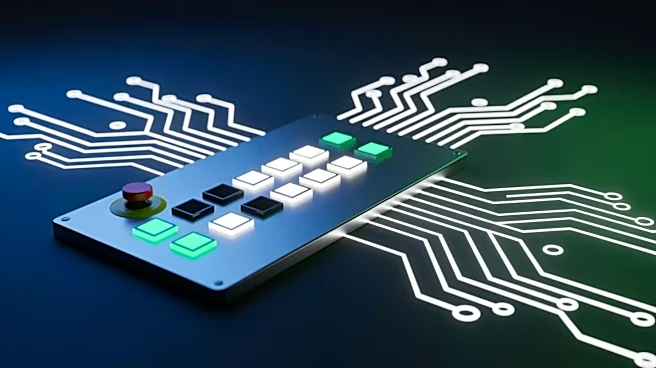
Parker Hannifin has announced the expansion of its SensoControl controller family, designed to offer modern connectivity and standardization for OEMs and end users. The updated controller family, manufactured in Germany, features faster response times,
higher measurement accuracy, and a robust industrial design. This expansion includes four variants—SCLTSDI, SCLSDI, SCTSDI, and SCTSDI-Modular—each tailored for specific monitoring tasks such as pressure, level, temperature, and process monitoring. The controllers are equipped with IO-Link and a new 0-10 V output option, facilitating easier integration into existing systems. This development aims to provide a scalable and reliable solution for various industrial applications, enhancing the efficiency and reliability of systems in demanding environments.
Why It's Important?
The expansion of Parker Hannifin's SensoControl controller family is significant for industries relying on precise monitoring and control solutions. By offering enhanced connectivity and standardization, the new controllers can improve operational efficiency and system reliability across various sectors, including industrial machinery, automotive, and power generation. The integration of IO-Link and the 0-10 V output option allows for seamless incorporation into existing infrastructures, reducing the complexity and cost of system upgrades. This move positions Parker Hannifin as a key player in the market for advanced monitoring solutions, potentially increasing its market share and influence in the industrial automation sector.
What's Next?
As Parker Hannifin rolls out its expanded SensoControl controller family, industries are likely to adopt these solutions to enhance their monitoring capabilities. The company may continue to innovate and expand its product offerings to meet the evolving needs of its customers. Additionally, the adoption of these controllers could lead to increased demand for Parker Hannifin's products, prompting further research and development efforts to maintain a competitive edge. Stakeholders in the industrial automation sector will be closely monitoring the impact of these new controllers on operational efficiencies and system integrations.