
What's Happening?
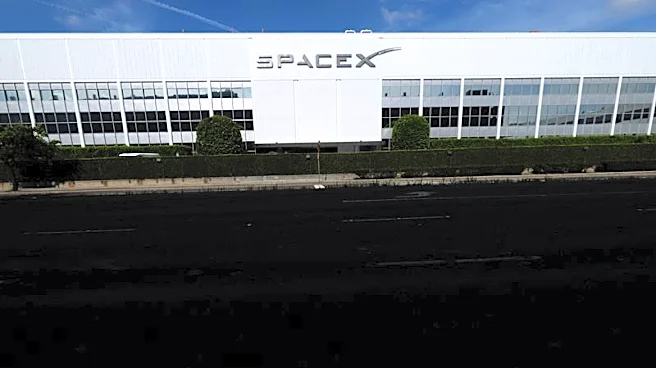
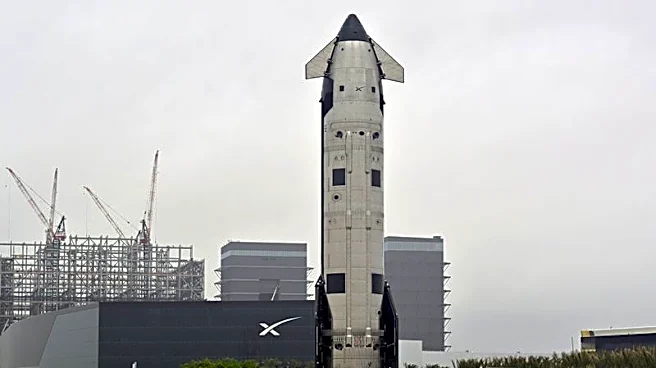
Elon Musk's SpaceX is preparing to launch what could become the largest initial public offering (IPO) in history, with plans to list on the Nasdaq under the ticker symbol 'SPCX'. The company has announced
that retail investors will have the opportunity to purchase Class A shares through five major online brokerage platforms: Charles Schwab, Fidelity, Robinhood, SoFi, and E-Trade by Morgan Stanley. This move allows everyday traders to participate in the IPO at the same price and timing as institutional investors. SpaceX aims to raise between $75 billion and $85 billion, potentially valuing the company at $1.5 trillion to $2 trillion. Despite reporting a $4.9 billion net loss on $18.7 billion in revenue last year, the company is pushing forward with its ambitious plans, which include significant investments in artificial intelligence and space technologies.
Why It's Important?
The SpaceX IPO is significant as it could set a new benchmark for public offerings, potentially revitalizing the IPO market, which has been sluggish due to economic uncertainties like inflation and rising interest rates. The inclusion of retail investors in such a high-profile IPO is notable, as it democratizes access to what is typically a domain reserved for institutional investors. This could lead to increased market volatility, as retail investors are known for their dynamic trading behaviors. Additionally, the IPO's success could influence other tech and space companies considering going public, although SpaceX's unique position and valuation may not be easily replicated.
What's Next?
As SpaceX moves closer to its IPO, market analysts and investors will be closely watching for further details on the company's financial health and strategic plans. The dual-class share structure, which allows Elon Musk to maintain significant control, may raise governance concerns among potential investors. The market's reaction to the IPO will be a critical indicator of investor confidence in high-valuation tech companies. Furthermore, the performance of SpaceX's shares post-IPO could influence the strategies of other companies contemplating public offerings.
Beyond the Headlines
The SpaceX IPO highlights broader trends in the tech and space industries, where companies are increasingly seeking public funding to support ambitious projects. The potential $2 trillion valuation underscores the market's appetite for innovative companies with visionary leadership, despite financial losses. However, the governance structure, which heavily favors Musk's control, may prompt discussions about corporate governance standards in tech IPOs. The outcome of this IPO could also impact regulatory scrutiny on dual-class share structures and their implications for shareholder rights.