





What's Happening?
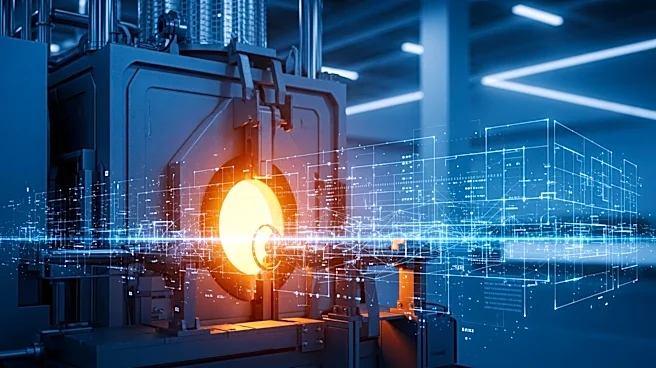
Glass Futures has developed an AI-driven digital twin of its glass furnace at its global center in St Helens. This innovative model allows for the testing and prediction of new methods for glass production. By integrating real and simulated data with
physics-informed modeling, the digital twin can process over 11,000 calculations simultaneously, providing accurate predictions of glass output. The project, in collaboration with NVIDIA and the University of Liverpool's Virtual Engineering Centre, aims to drive innovation by enabling manufacturers to experiment with new fuels and techniques, such as electric heating and bubbling, with confidence in the predicted outcomes.
Why It's Important?
The AI-GLASS project represents a significant advancement in industrial digitalization, offering the potential to transform glass manufacturing by reducing experimentation barriers and accelerating the adoption of low-carbon alternatives. This initiative supports the industry's move towards more sustainable and efficient production methods, which is crucial in the context of global efforts to reduce carbon emissions. By enabling manufacturers to test and implement new technologies more rapidly, the project could lead to significant improvements in energy efficiency and cost savings, benefiting both the environment and the economy.
What's Next?
Glass Futures plans to collaborate with its members and partners across various sectors, including steel and ceramics, to apply the digital twin technology to other industrial processes. The organization aims to support other teams in digitalizing their operations, potentially leading to broader adoption of AI-driven solutions in manufacturing. This could result in a more widespread shift towards sustainable practices across industries, further contributing to global decarbonization efforts.
Beyond the Headlines
The development of the AI-driven digital twin highlights the growing importance of artificial intelligence in industrial processes. By merging advanced modeling with AI, industries can explore new materials and fuels more efficiently, reducing risks and accelerating progress towards sustainability. This project also underscores the potential for AI to revolutionize traditional manufacturing sectors, paving the way for more innovative and environmentally friendly production methods.