



What's Happening?
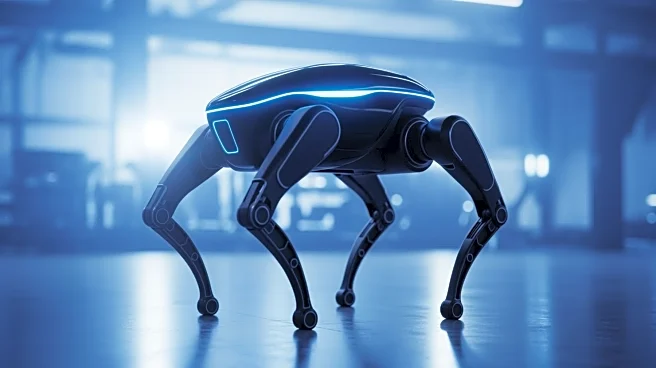
Unitree has launched the A2 quadruped robot, designed for industrial inspection, logistics support, and research applications. This development marks a shift from laboratory demonstrations to field-deployable systems capable of performing repeatable tasks.
The A2 robot features advanced legged locomotion, on-robot perception, and battery management, which collectively enhance its real-world duty cycles. The robot can carry a standing load of 100 kg and a walking payload of approximately 25 kg, with a maximum range of 20 km when unloaded. It is equipped with dual hot-swappable batteries, 3D LiDAR, and an HD camera. The A2's performance is influenced by the balance between payload, speed, and endurance, as well as terrain and software configurations. Organizations considering the A2 are advised to align their tasks with these trade-offs rather than focusing solely on headline specifications.
Why It's Important?
The introduction of the Unitree A2 robot represents a significant advancement in the field of robotics, particularly for industries requiring reliable and efficient inspection and logistics solutions. The robot's ability to perform in diverse environments with varying payloads and terrains could revolutionize how industries approach automation and robotics. This development could lead to increased efficiency and reduced operational costs for businesses that adopt such technology. Additionally, the A2's capabilities in research applications could further the development of embodied intelligence and autonomous systems, potentially leading to new innovations in robotics and artificial intelligence.
What's Next?
As the Unitree A2 becomes more widely adopted, industries may begin to integrate these robots into their operations, leading to potential shifts in workforce dynamics and operational strategies. Companies might explore new applications for the A2, expanding its use beyond initial industrial and research purposes. The success of the A2 could also prompt further advancements in robotic technology, encouraging other manufacturers to develop similar or improved systems. Stakeholders in the robotics industry will likely monitor the A2's performance closely to assess its impact and potential for broader deployment.
Beyond the Headlines
The deployment of the Unitree A2 robot raises questions about the future of labor in industries heavily reliant on manual inspection and logistics tasks. As automation becomes more prevalent, there may be ethical and economic considerations regarding job displacement and the need for workforce retraining. Additionally, the integration of advanced robotics into everyday operations could lead to discussions about regulatory standards and safety protocols to ensure the responsible use of such technology.