








What's Happening?
The additive manufacturing (AM) market using metal powders is projected to experience significant growth, expanding from USD 0.847 billion in 2026 to USD 5.7 billion by 2036. This growth, representing a 21.0% compound annual growth rate (CAGR), is largely
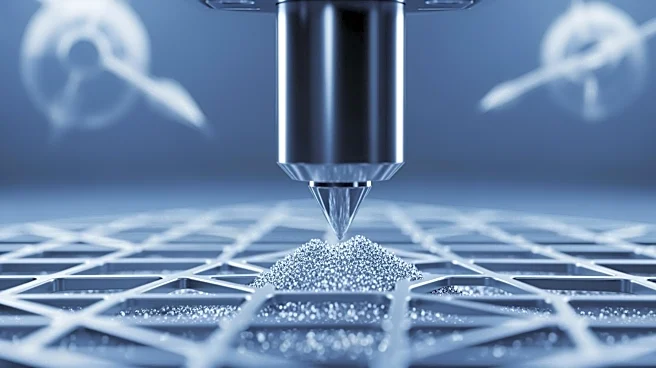
driven by the aerospace and defense sectors' increasing demand for lightweight, high-performance components. The shift from prototyping to full-scale industrial production is facilitated by advancements in powder metallurgy and 3D printing technologies. Metal AM allows for near-net-shape production, reducing material waste and enabling complex geometries that were previously unattainable. The market's expansion is also supported by technological advancements in laser powder bed fusion, electron beam melting, and directed energy deposition, which enhance precision and efficiency.
Why It's Important?
The expansion of the metal additive manufacturing market is significant for several industries, particularly aerospace and defense, which require lightweight and durable components. The ability to produce complex parts with minimal waste positions metal AM as a key player in next-generation manufacturing. This growth also reflects broader industrial trends towards customization and low-volume production, which are increasingly important in sectors like healthcare and specialized defense. The U.S. market, while growing steadily, is transitioning from prototyping to high-volume certified production, indicating a maturation of the technology and its applications. This shift could lead to increased competitiveness and innovation within the U.S. manufacturing sector.
What's Next?
As the market continues to grow, key players are likely to focus on innovation in materials and system integration to maintain competitive advantage. The aerospace sector's adoption of metal AM for flight-critical components under FAA and military standards is expected to accelerate. Additionally, the integration of Industry 4.0 technologies, such as AI and machine learning, will likely enhance production workflows and reduce defects. The U.S. market is expected to remain a leader in value, but rapid growth in regions like China and India suggests a competitive global landscape. Companies may need to adapt to these dynamics by investing in new technologies and expanding their capabilities.
Beyond the Headlines
The rise of metal additive manufacturing could have broader implications for environmental sustainability in manufacturing. By reducing material waste and enabling more efficient production processes, metal AM supports efforts to minimize the environmental impact of industrial activities. Furthermore, the technology's ability to produce complex, lightweight components could lead to more energy-efficient products, particularly in the aerospace and automotive industries. As the market evolves, ethical considerations around intellectual property and the standardization of production processes may also emerge as important issues.