



What's Happening?
Gold prices have remained relatively stable, hovering around $4,700 per ounce, despite ongoing geopolitical tensions and economic uncertainties. The metal's price has been fluctuating within a range of $4,600 to $4,900, with recent trading volumes showing
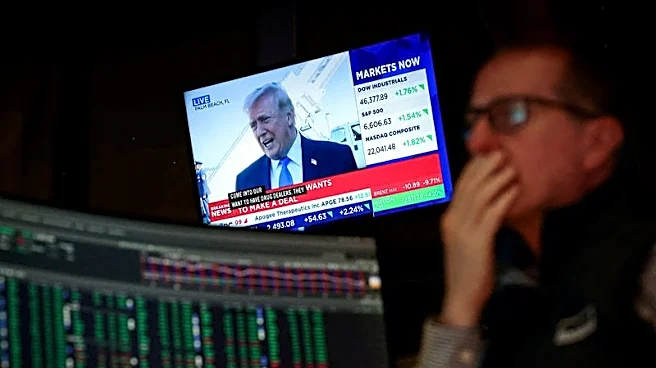
a decrease. This stability is attributed to the stalled US-Iran peace talks, which have led to a rise in oil prices and increased inflationary pressures. President Trump has indicated that Iran is welcome to negotiate, but emphasized that Iran must not develop nuclear weapons. The situation has been further complicated by the cancellation of a trip by US envoys to Pakistan, a mediator in the conflict. As a result, energy exports from the Middle East have been disrupted, contributing to higher oil prices and inflation. Despite these challenges, gold continues to be viewed as a safe-haven asset, providing a hedge against systemic instability.
Why It's Important?
The stability of gold prices amidst geopolitical tensions and inflation concerns highlights its role as a safe-haven asset. As oil prices rise due to the US-Iran conflict, inflationary pressures increase, potentially leading to higher interest rates. While high interest rates can make yield-generating assets more attractive, gold's lack of counterparty risk and its function as a hedge against systemic instability maintain its appeal. The ongoing geopolitical divisions and economic uncertainties underscore the importance of gold as a diversification tool in investment portfolios. Central banks continue to accumulate gold, reinforcing its status as a critical component of financial stability strategies.
What's Next?
Market participants are closely monitoring the US Federal Reserve's upcoming interest rate decision, which could impact gold's attractiveness as an investment. If interest rates rise significantly, it may affect gold's appeal compared to yield-generating assets. However, the ongoing geopolitical tensions and economic uncertainties are likely to sustain demand for gold as a safe-haven asset. The resolution of the US-Iran conflict and its impact on oil prices will also be key factors influencing gold's future trajectory.
Beyond the Headlines
Gold's current price stability may indicate a consolidation phase rather than a decline in its appeal. The metal's role as a hedge against systemic instability and its lack of counterparty risk make it a valuable asset during periods of economic uncertainty. The ongoing accumulation of gold by central banks, despite high prices, suggests a long-term strategic focus on maintaining financial stability. As geopolitical tensions and economic uncertainties persist, gold's function as a diversification tool and a hedge against systemic risks remains critical.