
What's Happening?
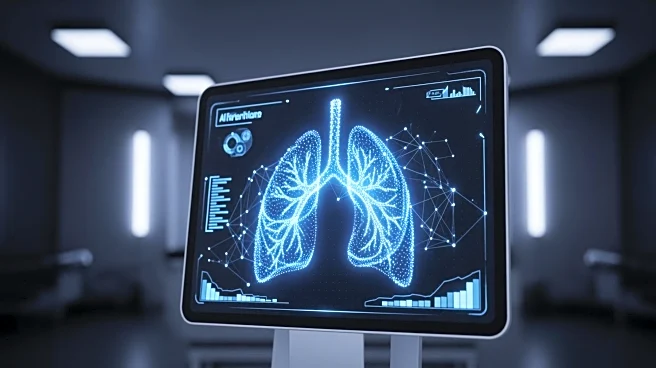
Median Technologies has announced a collaboration with Tempus AI to distribute its eyonis® LCS software, an AI-powered medical device for lung cancer screening, across the United States. This partnership
follows the FDA's 510(k) clearance of eyonis® LCS, which is designed to detect and characterize lung cancer in low-dose CT scans with high sensitivity and specificity. The software will be integrated into the clinical workflow through Tempus's Pixel platform, which is an AI-enabled solution that provides advanced analysis and automated reporting from radiology images. The collaboration aims to enhance the early detection and management of lung cancer by providing U.S. imaging providers with sophisticated tools to improve diagnostic accuracy and efficiency.
Why It's Important?
This collaboration is significant as it leverages AI technology to potentially transform lung cancer screening and diagnosis in the U.S., where approximately 14.5 million people are eligible for such screenings. By integrating eyonis® LCS into the Tempus Pixel platform, the partnership aims to improve the standard of care and reduce lung cancer mortality through earlier and more accurate detection. The use of AI in healthcare, particularly in precision medicine, is a growing trend that promises to enhance patient outcomes by providing personalized and data-driven treatment options. This initiative could set a precedent for future collaborations in the healthcare industry, emphasizing the role of AI in improving diagnostic processes and patient care.
What's Next?
The collaboration between Median Technologies and Tempus is expected to facilitate the national rollout of eyonis® LCS, with revenues shared between the two companies. Median Technologies is also pursuing European regulatory approval for the software, with plans to obtain CE marking by the second quarter of 2026. As the partnership progresses, it will be crucial to monitor the adoption rate of the software among U.S. imaging providers and its impact on lung cancer screening programs. Additionally, the collaboration may prompt other healthcare technology companies to explore similar partnerships, further integrating AI into medical diagnostics and treatment.