

What's Happening?
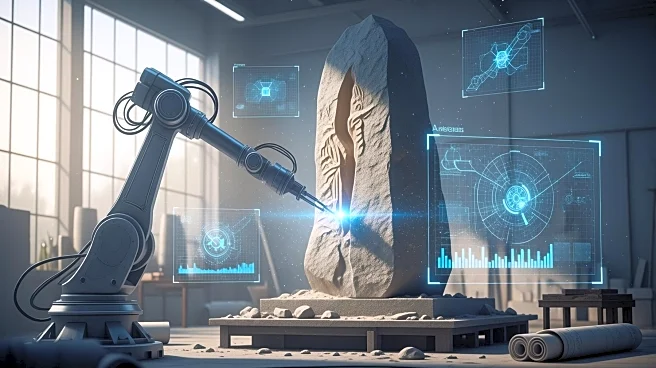
Joakim Målare, operating from a workshop in an old warehouse on Lake Vänern, is transforming the way civic monuments and large-scale art pieces are constructed. Utilizing two secondhand industrial robots and advanced CAD/CAM systems, Målare creates full-scale
monuments and theme park elements from digital models. His process involves milling negatives directly from digital designs, bypassing traditional mold-making steps, which saves time and reduces errors. Målare's approach integrates digital modeling with physical fabrication, allowing artists, architects, and fabricators to work from the same geometry, ensuring precision and alignment from concept to installation. His setup includes a combination of software and hardware that allows for efficient and accurate production, making it possible to execute complex designs with predictable costs.
Why It's Important?
Målare's innovative use of digital technology in monument construction has significant implications for the art and construction industries. By reducing the time and cost associated with traditional mold-making and fabrication processes, his methods democratize access to large-scale production capabilities. This approach allows smaller workshops to take on projects that would typically require factory-level resources, thereby lowering the barrier to entry for independent artists and regional ateliers. Additionally, the precision and predictability of Målare's methods enhance the quality of public art installations, ensuring that complex designs are faithfully executed. This could lead to more ambitious public art projects and architectural designs being realized without the need for increased budgets.
What's Next?
As Målare's techniques gain recognition, it is likely that more workshops will adopt similar digital-to-physical processes, leading to a shift in how public art and architectural projects are executed. The use of secondhand robots and open-source software could become more widespread, enabling a broader range of artists and fabricators to participate in large-scale projects. This could result in a more diverse array of public art and architectural designs, as well as increased collaboration between artists, architects, and fabricators. Additionally, the integration of digital modeling with physical fabrication may lead to new roles and opportunities within the art and construction industries, as traditional craft skills are combined with modern technology.
Beyond the Headlines
Målare's work highlights the potential for digital technology to transform traditional industries by bridging the gap between digital design and physical production. His approach not only streamlines the fabrication process but also preserves the artistic intent of the original design, ensuring that the final product reflects the artist's vision. This fusion of technology and craftsmanship could lead to a reevaluation of the role of the artist in the production process, as digital tools become an integral part of artistic expression. Furthermore, the environmental impact of Målare's methods, which reduce material waste and energy consumption, could contribute to more sustainable practices in the art and construction industries.