





What's Happening?
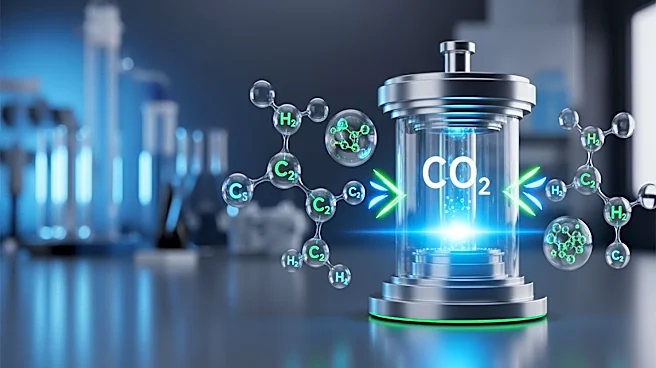
Researchers at the University of Chicago Pritzker School of Molecular Engineering, in collaboration with Argonne National Laboratory, have developed an integrated system for capturing and converting carbon dioxide (CO2). This system uses non-aqueous electrolytes,
specifically dimethyl sulfoxide (DMSO), to enhance the efficiency of CO2 capture and conversion processes. The new method allows for a one-to-one amine-to-CO2 binding stoichiometry, doubling the capture capacity compared to traditional aqueous systems. Additionally, the system employs zinc as a catalyst, which is more abundant and cost-effective than silver, achieving a conversion efficiency of approximately 78%. This innovation could significantly streamline carbon utilization workflows and reduce operational costs.
Why It's Important?
The development of this integrated CO2 capture and conversion system represents a significant advancement in efforts to mitigate climate change. By improving the efficiency and cost-effectiveness of carbon capture technologies, this system could facilitate the reduction of industrial carbon emissions. The use of abundant materials like zinc and the elimination of water in the process could lower costs and make the technology more accessible for widespread industrial application. This aligns with global decarbonization goals and could encourage further investment in carbon management technologies, ultimately contributing to a reduction in greenhouse gas emissions.
What's Next?
While the system shows promise, further research and development are needed to scale the technology for industrial use. Challenges such as achieving sustained catalyst stability and enhancing reaction rates must be addressed. The researchers are also focusing on optimizing reactor designs to improve efficiency at larger scales. If successful, this technology could be deployed in power plants and manufacturing facilities, converting waste CO2 into valuable products on-site. Continued collaboration between academic institutions and national laboratories will be crucial in advancing this technology from the laboratory to real-world applications.