



What's Happening?
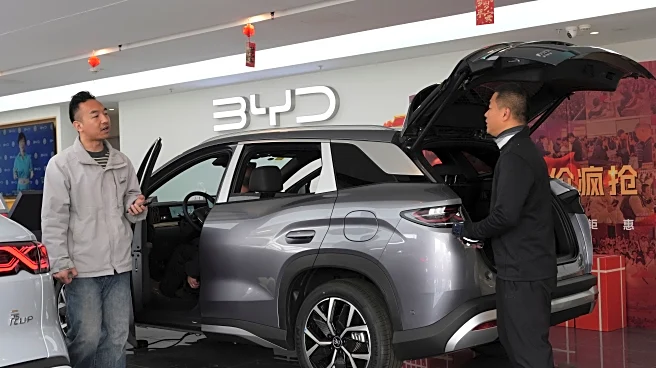
BYD, a leading electric vehicle manufacturer, has informed analysts of its expectation to achieve 1.5 million overseas vehicle sales in 2026. This projection surpasses the initial target of 1.3 million set earlier in January. The announcement follows
a private briefing after the company reported disappointing Q4 2025 results. Despite being the world's top-selling EV maker, BYD experienced its first annual profit decline in four years, even as it surpassed Tesla in sales in 2025. The company’s financial struggles are partly due to aggressive pricing strategies that have led to unprofitable domestic sales in China, as estimated by Citigroup. Consequently, BYD's international operations are now crucial for maintaining profitability.
Why It's Important?
The significance of BYD's announcement lies in its potential impact on the global automotive market and the company's financial health. As BYD shifts focus to international markets, it highlights the growing importance of global sales for Chinese automakers facing domestic challenges. The company's ability to achieve higher margins abroad, due to higher average sticker prices, is critical for offsetting losses in China. Additionally, BYD's expansion into new markets, including the establishment of manufacturing plants in various countries, positions it to mitigate risks associated with geopolitical tensions and trade barriers. This strategy could influence other automakers to similarly diversify their operations.
What's Next?
To meet its ambitious sales target, BYD plans to expand its global manufacturing footprint significantly. New plants are being developed in countries such as Brazil, Hungary, and Turkey, among others. The company is also exploring opportunities to acquire existing facilities, like a shuttered Nissan-Mercedes-Benz plant in Mexico. Furthermore, BYD aims to enhance its international presence by deploying ultra-fast charging infrastructure outside China by 2027. This includes a second-generation blade battery capable of rapid charging, addressing infrastructure gaps that have hindered its overseas expansion. These developments are expected to bolster BYD's competitive edge in the global EV market.
Beyond the Headlines
BYD's strategic shift underscores broader trends in the automotive industry, where geopolitical factors and trade policies increasingly influence business decisions. The company's efforts to establish a robust international presence reflect a need to navigate complex trade environments, such as the EU's anti-subsidy tariffs and the U.S.'s high import rates on Chinese-made EVs. Additionally, BYD's focus on infrastructure development highlights the critical role of charging networks in supporting EV adoption. As the company advances its technology and expands its market reach, it may set new standards for innovation and sustainability in the automotive sector.