
What's Happening?
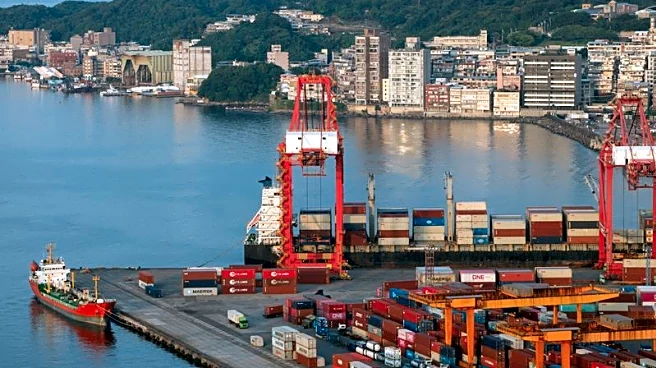
The Trump administration has finalized a trade agreement with Taiwan, significantly reducing tariff barriers between the two nations. Under the deal, Taiwan will remove or reduce 99% of its tariffs on U.S.
imports, while most of Taiwan's exports to the U.S. will be taxed at a 15% rate, aligning with other Asia-Pacific partners like Japan and South Korea. This agreement is part of a broader strategy to strengthen economic ties and address the trade imbalance, which reached nearly $127 billion in 2025. The deal also includes substantial Taiwanese investments in U.S. industries, particularly in computer chips, artificial intelligence, and energy, totaling $250 billion, with an additional $250 billion in credit guarantees for smaller businesses. This move is expected to bolster U.S. manufacturing capabilities, especially in the semiconductor sector.
Why It's Important?
This trade agreement is pivotal for both the U.S. and Taiwan, as it aims to balance trade relations and enhance economic cooperation. For the U.S., the deal is a strategic step towards reshoring semiconductor manufacturing, a critical industry for national security and technological advancement. The Taiwanese investments are expected to create 'world-class' industrial parks in the U.S., potentially reducing dependency on foreign chip production. For Taiwan, the agreement provides a competitive edge by leveling the playing field with other major economies and securing its position as a strategic partner in high technology. The deal also reflects President Trump's ongoing efforts to strengthen U.S. economic interests in the Asia-Pacific region.
What's Next?
The agreement will be submitted to Taiwan's legislature for approval, and its implementation could lead to significant developments in U.S.-Taiwan relations. The U.S. may see increased domestic production of advanced technologies, potentially reducing the trade deficit. Additionally, the deal could influence future trade negotiations with other countries in the region. As Taiwan invests in U.S. industries, American companies are also expected to invest in Taiwan, fostering mutual economic growth. The agreement may also impact geopolitical dynamics, given Taiwan's complex relationship with China.
Beyond the Headlines
The trade deal highlights the intricate balance of economic and political interests in the Asia-Pacific region. It underscores the importance of semiconductor manufacturing as a strategic asset, with implications for global supply chains and technological leadership. The agreement may also serve as a model for future trade negotiations, emphasizing the role of reciprocal investments in strengthening bilateral ties. Furthermore, it reflects the broader trend of nations seeking to secure critical industries amid global uncertainties.