
What's Happening?
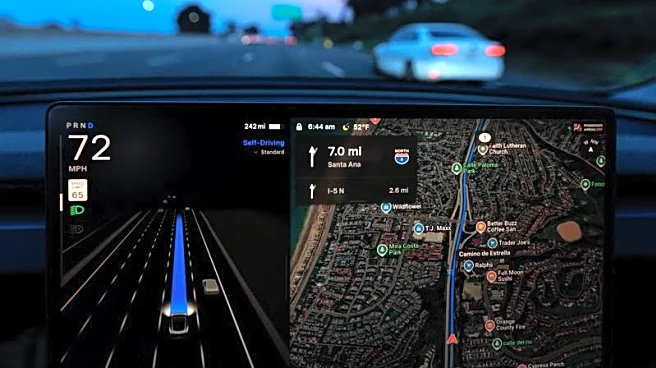
Federal auto regulators have intensified their investigation into Tesla's self-driving feature following several crashes involving the technology. The National Highway Traffic Safety Administration (NHTSA) is examining nine incidents where Tesla's self-driving software
failed to alert drivers to take control in poor visibility conditions, such as fog. This escalation could lead to enforcement actions, including a potential recall of 3.2 million vehicles. The scrutiny comes as Tesla CEO Elon Musk plans to introduce a new model without a steering wheel or pedals, and aims to expand the company's self-driving software. Tesla's stock fell by 3.2% following the announcement. The company is also facing other regulatory probes related to its Full Self-Driving (FSD) software, which has been criticized for its misleading name.
Why It's Important?
The increased regulatory scrutiny on Tesla's self-driving technology highlights significant safety concerns that could impact the company's future operations and reputation. If the investigation leads to a recall, it could result in substantial financial costs and damage to Tesla's brand. The situation underscores the challenges of advancing autonomous vehicle technology while ensuring public safety. The outcome of this investigation could influence regulatory approaches to self-driving technologies across the automotive industry, potentially affecting other manufacturers and the pace of innovation in autonomous vehicles.
What's Next?
The NHTSA's investigation will move to an 'engineering analysis,' a more serious level of scrutiny that could lead to enforcement actions. Tesla plans to roll out its robotaxi service in several U.S. cities this year, which may face delays or additional regulatory hurdles. The company is also preparing to launch its Cybercab model, which lacks traditional controls. Stakeholders, including investors and consumers, will be closely watching the investigation's progress and Tesla's responses to regulatory challenges.