




What's Happening?
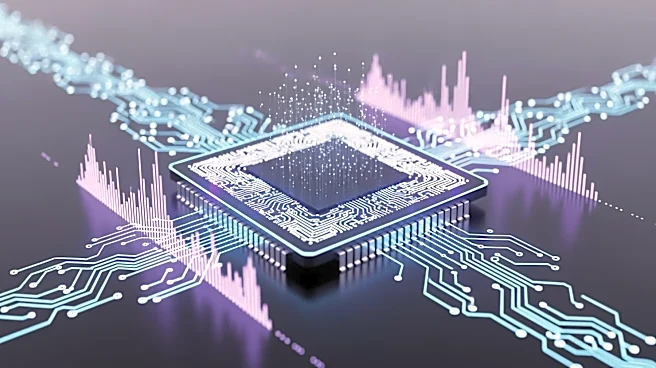
Researchers at the Henan Key Laboratory of Quantum Information and Cryptography and Nanyang Technological University have introduced predictive surrogates, a new computational model designed to enhance the efficiency of quantum computing. These models,
detailed in a paper published in Nature Communications, aim to predict the outcomes of quantum processors using classical machine learning techniques. By training on a small dataset from a quantum processor, predictive surrogates can forecast the results of future computations without the need for direct access to expensive quantum hardware. This development addresses two major challenges in quantum computing: the high cost and limited access to quantum processors, and the slow processing speeds due to the need for repeated measurements.
Why It's Important?
The introduction of predictive surrogates could significantly democratize access to quantum computing by reducing the reliance on costly and scarce quantum hardware. This advancement allows a broader range of researchers and industries to leverage quantum computing capabilities without the prohibitive costs associated with direct hardware use. By minimizing the need for repeated hardware queries, predictive surrogates can lower operational costs and make quantum computing more accessible for solving complex problems in fields such as chemistry, materials science, and fundamental science. This could accelerate innovation and research in these areas, potentially leading to breakthroughs that were previously constrained by resource limitations.
What's Next?
The research team plans to continue refining their predictive surrogate models to enhance their accuracy and applicability across various quantum computing tasks. Future research will focus on expanding the framework to accommodate different quantum computing platforms, such as continuous-variable systems and fermionic systems. Additionally, the team aims to deepen the theoretical understanding of predictive surrogates and explore their potential in supporting fault-tolerant quantum computing and large quantum networks. These efforts could further enhance the scalability and effectiveness of quantum computing, making it a more viable tool for a wider array of scientific and industrial applications.