






What's Happening?
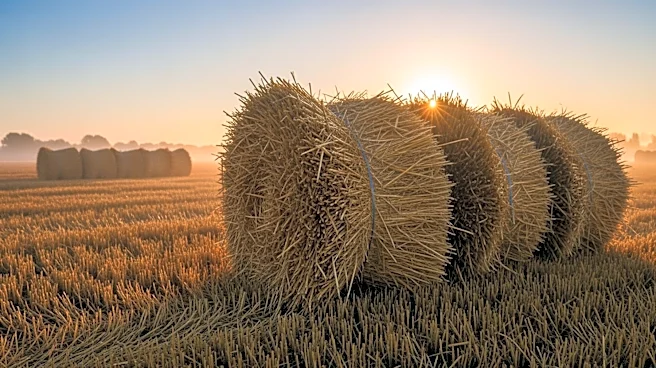
A study published in Scientific Reports highlights the potential of agricultural straw residues as bioenergy feedstocks to reduce greenhouse gas emissions. Researchers evaluated eight types of straw, including barley, corn, and wheat, from Southern Spain,
finding that these materials have favorable energy properties. The study emphasizes the underutilized potential of straw biomass as a renewable energy resource, capable of significantly lowering net emissions. The research involved standardized testing to assess the energy performance of straw, revealing that most types have moderate ash content and strong calorific values, making them competitive alternatives to conventional biomass fuels.
Why It's Important?
The findings underscore the importance of exploring alternative energy sources to reduce reliance on fossil fuels. Utilizing agricultural straw as a bioenergy feedstock can contribute to cleaner energy production and support circular economy principles by transforming waste into valuable resources. This approach not only helps in reducing emissions but also strengthens rural economies by providing new revenue streams for farmers. The study's predictive models offer a cost-effective method for assessing biomass quality, potentially accelerating the adoption of straw-based bioenergy systems.
What's Next?
Future research may focus on optimizing the use of agricultural straw in bioenergy systems, including strategies for improving fuel quality and reducing environmental impacts. Policymakers and industry stakeholders might explore incentives to encourage the adoption of straw-based bioenergy, while researchers continue to refine predictive models for biomass assessment. The integration of agricultural residues into energy production could play a crucial role in achieving sustainability goals and reducing the carbon footprint of the energy sector.