







What's Happening?
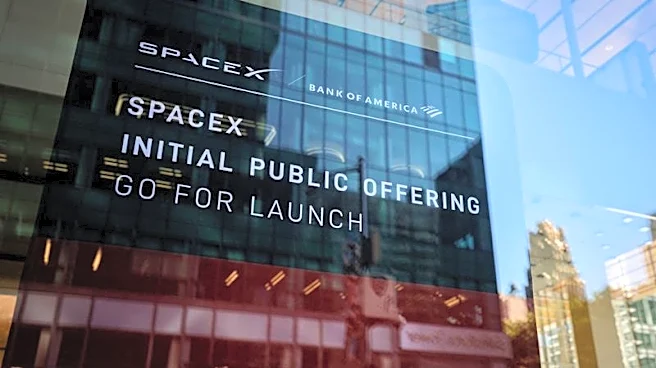
SpaceX, the rocket launch, computing, and satellite company, made a historic debut on the Nasdaq with its initial public offering (IPO). The company achieved the largest IPO ever, with a trading volume exceeding 500 million shares and a closing price
above $160, resulting in a first-day market capitalization of over $2.1 trillion. The stock opened at $150, significantly above its telegraphed offering price of $135 per share, and continued to rise in after-hours trading. Despite concerns about potential volatility due to a large retail allocation, trading remained stable, with the stock reaching a high of $176.52 before settling at $160.95.
Why It's Important?
The successful IPO of SpaceX marks a significant milestone in the financial markets, highlighting investor confidence in the company's future prospects. The substantial market capitalization underscores the growing interest in space exploration and technology sectors. This event could potentially influence other companies in the industry to consider public offerings, thereby increasing investment opportunities. The stability observed during trading, despite a large retail allocation, may encourage more retail investors to participate in future IPOs, potentially altering the dynamics of stock market participation.
What's Next?
Following the IPO, SpaceX is expected to focus on expanding its operations and leveraging the capital raised to advance its technological capabilities and market reach. Investors and analysts will likely monitor the company's performance closely, particularly its ability to meet growth expectations and maintain its market position. The IPO's success may also prompt other private space companies to explore public offerings, potentially leading to increased competition and innovation in the sector.