



What's Happening?
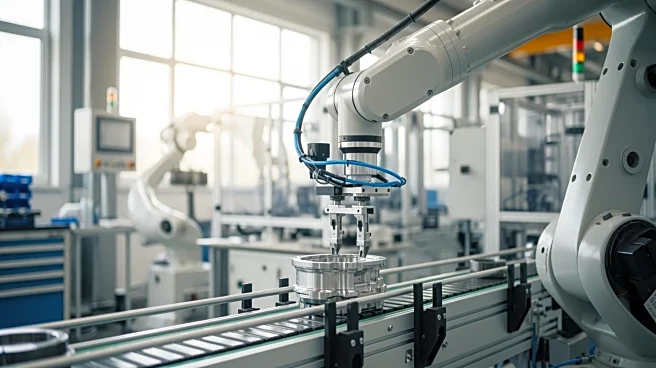
In Ballston Lake, New York, a small business owner named Steve has transformed a 600-square-foot shop into a fully automated factory, producing $3 million worth of products annually. Using self-built machinery costing under $10,000, Steve has automated the production of Seat Reviver, a boat cleaning product. The factory utilizes Arduino boards to control various production processes, including bottle filling and labeling. Steve's innovation began in March 2025, and within two months, he completed the setup. The factory's maximum output has been tested to produce $3 million worth of bottles annually, with an initial production of 10,000 units in the first month. Steve's approach highlights the potential for small businesses to scale operations
efficiently without significant overhead costs.
Why It's Important?
This development underscores the potential for small businesses to leverage automation and technology to compete with larger manufacturers. By building his own machinery, Steve has significantly reduced costs, allowing him to enter the market with minimal overhead. This approach could inspire other small business owners to explore similar strategies, potentially leading to increased innovation and competitiveness in the manufacturing sector. The success of Steve's automated factory also highlights the growing trend of using open-source technology, like Arduino, to streamline production processes, which could have broader implications for the manufacturing industry.
What's Next?
As Steve continues to refine and optimize his automated factory, there may be opportunities for further expansion or diversification of product lines. The success of Seat Reviver could lead to increased demand, prompting Steve to consider scaling up operations or exploring new markets. Additionally, other small business owners may take note of Steve's approach and seek to implement similar automation strategies, potentially leading to a shift in how small-scale manufacturing is conducted. The broader adoption of such technologies could drive innovation and efficiency across various industries.
Beyond the Headlines
Steve's achievement raises questions about the future of small-scale manufacturing and the role of technology in democratizing production capabilities. By reducing the cost barrier to entry, automation and open-source technology could enable more entrepreneurs to bring their products to market. This shift could lead to a more diverse and competitive manufacturing landscape, with small businesses playing a more significant role. Additionally, the environmental impact of such innovations could be positive, as more efficient production processes may lead to reduced waste and resource consumption.