



What's Happening?
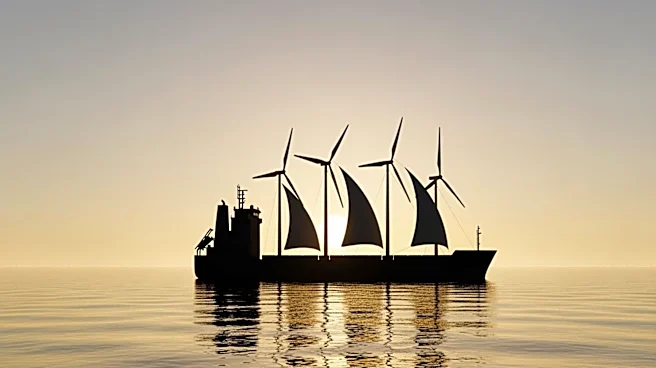
Mitsui O.S.K. Lines (MOL) has advanced its efforts in wind-assisted propulsion by retrofitting its hard-sail wind propulsion system onto the Kurotakisan Maru III, an 89,999 dwt coal carrier. This vessel, delivered in 2021, is part of the 'EeneX' series,
which are next-generation coal carriers designed with a double-hull structure to eliminate the need for ballast water. The Wind Challenger, developed in partnership with Oshima Shipbuilding, is a rigid sail system that automatically adjusts to wind conditions to optimize performance. MOL's initiative aims to reduce greenhouse gas emissions, with expected reductions of about five percent on Japan-Australia routes and eight percent on Japan-North America West Coast routes. This retrofit follows previous installations on other vessels, which have demonstrated significant reductions in fuel consumption and emissions.
Why It's Important?
The implementation of wind-assisted propulsion systems by MOL is a significant step towards reducing greenhouse gas emissions in the maritime industry. As global pressure mounts to address climate change, innovations like the Wind Challenger offer a viable solution for reducing the carbon footprint of shipping operations. This initiative not only aligns with MOL's goal of achieving net-zero emissions by 2050 but also sets a precedent for other shipping companies to adopt similar technologies. The potential reduction in fuel consumption and emissions can lead to cost savings and improved environmental performance, benefiting both the company and the broader industry.
What's Next?
MOL plans to expand the use of wind-assisted propulsion systems, with a target of installing the technology on 25 vessels by 2030 and 80 vessels by 2035. The company is also developing a new concept design for a liquefied CO2 carrier, featuring Wind Challenger units, in collaboration with Samsung Heavy Industries. This design has already received Approval in Principle from ClassNK, indicating its feasibility and safety. As MOL continues to innovate, the maritime industry may see increased adoption of wind propulsion systems, potentially leading to widespread reductions in emissions and operational costs.