





What's Happening?
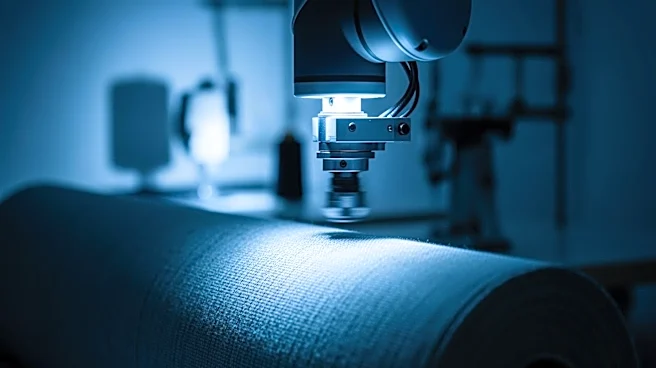
The integration of AI and robotics in the apparel manufacturing industry is facing significant challenges due to the complex nature of handling deformable materials like fabric. Traditional automation excels in tasks involving rigid materials, but fabric's
unpredictable behavior—such as stretching and wrinkling—poses difficulties for robots. The industry has long relied on sewing machines, which require human dexterity for tasks that machines struggle to replicate. The current challenge is to develop systems that can perceive, reason, and adapt in real-time, rather than simply executing pre-scripted motions. Advances in vision, simulation, and robot intelligence are moving towards more dexterous manipulation, but the transition from lab demonstrations to commercial deployment remains difficult. The focus is shifting from automating existing processes to redesigning them to better suit robotic capabilities.
Why It's Important?
The ability to automate the handling of deformable materials like fabric is crucial for the apparel industry, which faces global scale and cost pressures. Successfully developing AI systems that can manage these materials could revolutionize manufacturing, making it more efficient and less reliant on human labor. This would not only impact the apparel industry but also other sectors dealing with flexible materials, such as automotive interiors and aerospace composites. The shift towards AI-driven manufacturing could lead to shorter lead times, more responsive production, and reduced dependency on large production runs. This transformation could significantly alter the economic landscape of manufacturing, affecting jobs, production costs, and global supply chains.
What's Next?
The next phase of automation in manufacturing will focus on systems that can estimate material states, adapt to variations, and improve through use. This involves not just faster machines but smarter systems that integrate robotics, adhesives, and AI-driven controls. The industry is moving towards a model where improvements are software-driven, allowing for more flexible and responsive production processes. This shift will require significant investment in research and development to create systems that can generalize across different materials and products. As these technologies mature, they are expected to be evaluated based on production metrics like uptime, yield, and cycle time, marking a transition from experimental to practical applications.
Beyond the Headlines
The development of AI systems capable of handling deformable materials has broader implications beyond the apparel industry. It represents a foundational capability for industries working with soft goods and technical textiles. The ability to redesign manufacturing processes for intelligence rather than simply automating existing workflows could lead to a new era of manufacturing innovation. This approach emphasizes the integration of robotics, joining methods, and learning-based control as a single system, potentially leading to more sustainable and efficient production methods. The long-term impact could include a shift in how industries approach manufacturing, focusing on adaptability and learning rather than rigid processes.