
What's Happening?
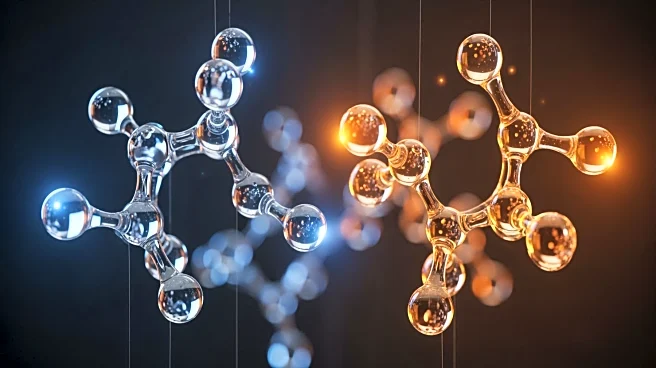
Researchers at the University of St Andrews have made a significant breakthrough in molecular chemistry by discovering a method to control chirality during the [1,2]-Wittig rearrangement. This process,
which reorganizes atoms within a molecule, was previously considered too unpredictable for selective synthesis. The new method involves a catalyst that guides the molecule through an initial asymmetric rearrangement, followed by a molecular reshuffle that maintains chirality. This discovery, published in Nature Chemistry, has the potential to revolutionize the production of single-enantiomer molecules, which are crucial in pharmaceuticals and materials manufacturing.
Why It's Important?
The ability to control chirality in chemical processes is crucial for the development of pharmaceuticals, as the 'handedness' of molecules can significantly affect their biological activity. This breakthrough could lead to more efficient and selective production methods, reducing costs and improving the quality of drugs and materials. The discovery also opens new avenues for research in asymmetric transformations, potentially leading to innovations in various chemical industries. For the scientific community, this advancement represents a fundamental shift in understanding stereochemistry, offering new tools for designing chemical reactions.