
What's Happening?
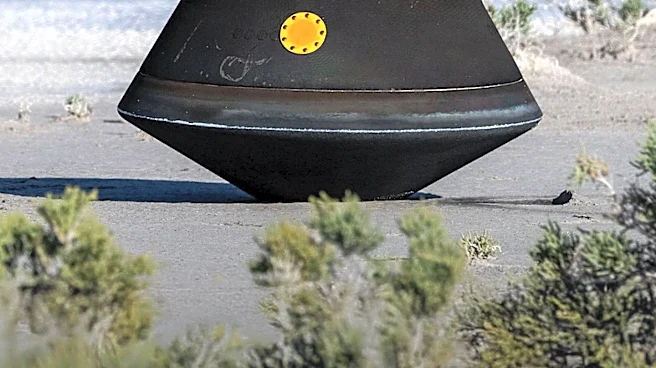
The Exploration Company has successfully completed a drop test of its Nyx spacecraft, designed for cargo transport to low Earth orbit, in California's Mojave Desert. The test involved a helicopter releasing
a model of the capsule, known as the Drop Test Vehicle (DTV), from an altitude of 2,800 meters. The capsule deployed two drogue parachutes for stabilization, followed by four main parachutes, ensuring a safe landing. This test is part of a broader qualification campaign for the Nyx parachute system, which is crucial for its future missions. The company has previously conducted water-impact tests in Italy to validate splashdown conditions. The Nyx capsule is slated for a 2028 orbital flight test, including a docking with the International Space Station. The Exploration Company is also developing rocket engines, such as the Huracan and Storm, for future lunar and cislunar missions.
Why It's Important?
The successful drop test marks a significant milestone in the development of the Nyx spacecraft, which is part of a broader effort to enhance commercial space capabilities. The Nyx capsule's ability to transport cargo to low Earth orbit could play a crucial role in supporting the International Space Station and other space missions. The development of new rocket engines like Huracan and Storm further positions The Exploration Company as a key player in the space industry, potentially contributing to future lunar exploration and cislunar activities. This progress aligns with global efforts to expand commercial space operations and reduce reliance on government-led initiatives.
What's Next?
The Exploration Company plans to continue its testing and development efforts, with a 2028 orbital flight test of the Nyx capsule on the horizon. This test will include a docking with the International Space Station, further validating the capsule's capabilities. The company is also seeking to raise $200 million to support its rocket engine projects, indicating ongoing investment in its space infrastructure. As the company advances its technology, it may attract more partnerships and collaborations within the space industry, potentially influencing the future of commercial space exploration.