



What's Happening?
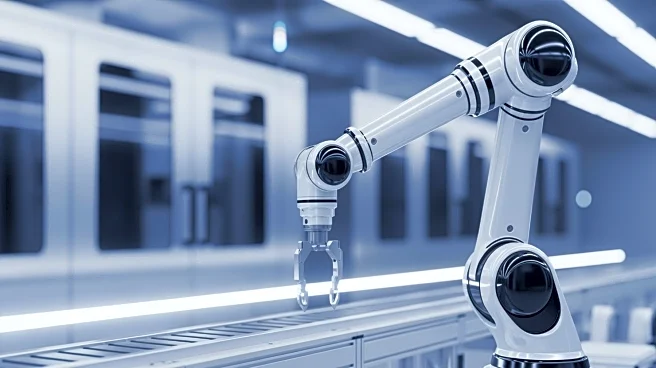
The concept of fully automated factories, often referred to as 'lights-out' manufacturing, is gaining traction in the industrial sector. These facilities operate with minimal human intervention, utilizing advanced robotics, artificial intelligence (AI),
and machine learning (ML) to manage production processes. The idea is not new, with historical roots in early automation technologies like waterwheels and windmills. However, the modern iteration of this concept is more sophisticated, allowing factories to function in complete darkness, hence the term 'dark factories.' Despite the technological advancements, there is an ongoing debate about the role of humans in these highly automated environments. The tension between human labor and machine efficiency is a recurring theme, as illustrated in Philip K. Dick's 1955 novelette 'Autofac,' which explores the challenges of autonomous production in a post-apocalyptic world.
Why It's Important?
The rise of 'lights-out' manufacturing has significant implications for the workforce and the economy. While automation can lead to increased efficiency and lower production costs, it also raises concerns about job displacement and the future role of human workers. Industries such as manufacturing, healthcare, transportation, and financial services are increasingly adopting these technologies, which could lead to a shift in labor dynamics. The challenge lies in finding a balance between leveraging technological advancements and maintaining meaningful employment opportunities for humans. This balance is crucial for ensuring that technological progress does not exacerbate economic inequality or lead to social unrest.
What's Next?
As industries continue to explore the potential of fully automated operations, there will likely be increased focus on developing policies and strategies to integrate human workers into these environments. This could involve retraining programs to equip workers with the skills needed to manage and maintain automated systems. Additionally, there may be a push for regulatory frameworks to address the ethical and economic implications of widespread automation. Stakeholders, including industry leaders, policymakers, and labor organizations, will need to collaborate to ensure that the transition to more automated systems is equitable and sustainable.
Beyond the Headlines
The shift towards 'lights-out' manufacturing raises broader questions about the future of work and the ethical considerations of automation. As machines become more capable, there is a risk of devaluing human labor and creativity. This could lead to a cultural shift in how society views work and productivity. Moreover, the reliance on automated systems could create vulnerabilities, such as cybersecurity risks and over-dependence on technology. Addressing these challenges will require a holistic approach that considers not only economic factors but also social and cultural dimensions.