



What's Happening?
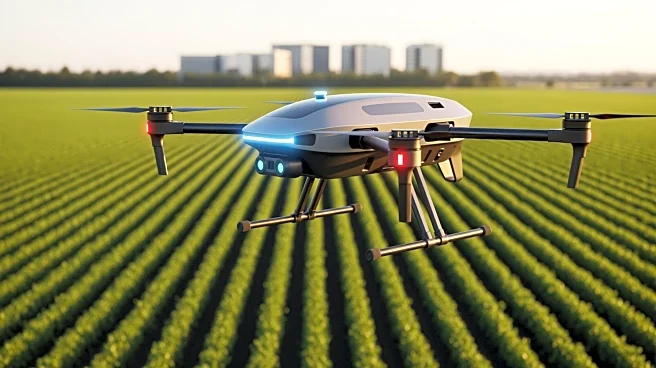
StarFront, a company specializing in smart agricultural technology, has launched its M150 agricultural drone in Silicon Valley, marking its first appearance in the North American market. The launch event attracted a diverse group of stakeholders, including
large-scale farm operators, agricultural distributors, industry media, and investment representatives. The M150 drone is designed to address common challenges in large-scale agriculture, such as low efficiency, labor shortages, and difficult terrain adaptability. It features advanced technologies like WD360 LiDAR, millimeter-wave phased array radar, and RTK centimeter-level positioning, enabling precise obstacle avoidance and autonomous flight. The drone's Smart Spraying System ensures efficient chemical application, while its robust adaptability allows it to perform effectively across various terrains. StarFront's strategy includes integrating satellites, drones, and ground-based sensors to create a multidimensional sensing network, aiming to enhance the global food supply chain.
Why It's Important?
The introduction of the M150 agricultural drone in the U.S. market represents a significant step in the evolution of smart agriculture. By addressing efficiency and adaptability issues, the drone has the potential to transform crop protection practices, making them more precise and less resource-intensive. This could lead to increased productivity and sustainability in the agricultural sector, benefiting large-scale farm operators and potentially reducing costs. The integration of advanced technologies in agriculture also aligns with broader trends towards digital transformation and data-driven decision-making in the industry. As the U.S. is a major player in global agriculture, the successful adoption of such technologies could influence practices worldwide, promoting more sustainable and efficient farming methods.
What's Next?
Following the U.S. launch, StarFront plans to continue its global expansion by embedding its technologies locally and tailoring solutions to meet specific market needs. The company aims to establish itself as a trusted global brand in smart agricultural technology. Future steps include deepening innovation, strengthening local ecosystems, and delivering customized solutions for different agricultural landscapes. Stakeholders in the agricultural sector, including policymakers and industry leaders, may closely monitor the impact of these technologies on productivity and sustainability. The success of the M150 drone in the U.S. could pave the way for further technological advancements and collaborations in the agricultural industry.