







What's Happening?
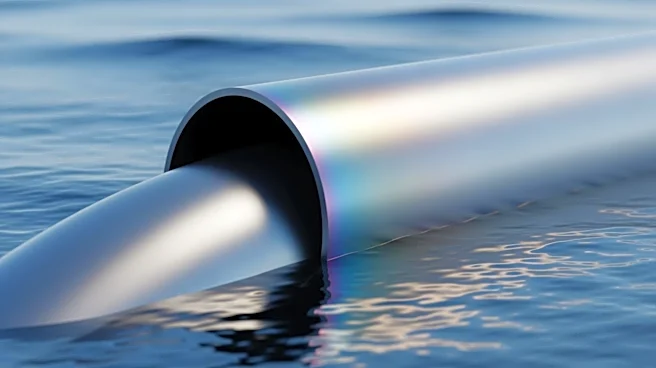
Researchers have optimized the laser cladding process of Inconel 625 on API 5L X65 carbon steel to improve the microstructure and corrosion resistance of steel coatings. This process, detailed in a study published in Scientific Reports, uses response
surface methodology to control cladding thickness and the interfacial martensite layer, enhancing the durability of steel surfaces for marine pipeline applications. The laser cladding technique offers advantages over traditional methods by allowing precise control over composition and microstructure through laser energy input. The study highlights the importance of optical parameters, such as laser power and beam diameter, in dictating heat input and affecting melt-pool dynamics, which are crucial for producing defect-free coatings.
Why It's Important?
The optimization of laser cladding processes is significant for industries relying on durable and corrosion-resistant materials, such as marine pipeline construction. By enhancing the mechanical reliability and corrosion resistance of steel coatings, this research could lead to longer-lasting infrastructure and reduced maintenance costs. The ability to precisely control the microstructure of coatings through laser cladding could also lead to advancements in other sectors requiring high-performance materials. This development underscores the potential for laser technology to improve industrial processes and product longevity.
What's Next?
The study provides a framework for scalable, automated laser cladding processes, suggesting potential for broader industrial application. Future research may focus on further refining the optical parameters to enhance the quality and performance of coatings. Additionally, the integration of feedback from thickness and microstructural sensors could lead to more precise control of melt-pool thermodynamics, potentially opening new avenues for material innovation in various industries.