

What's Happening?
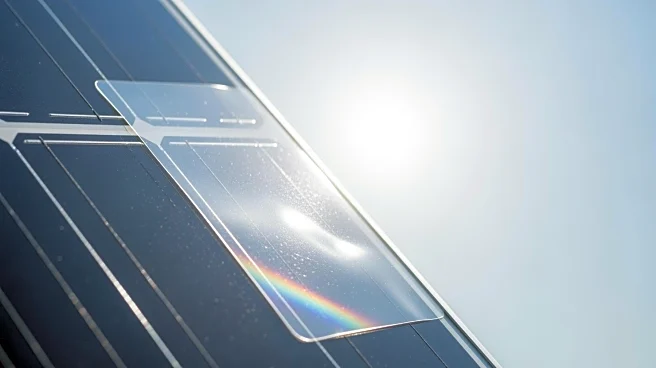
Researchers at the Massachusetts Institute of Technology have developed a new polymer coating, 2DPA-1, designed to enhance the durability of solar panels by preventing gas permeation. This coating, only 60 nanometers thick, is intended to protect perovskite solar cells from corrosive gas damage, thereby extending their lifespan. Unlike traditional coatings, 2DPA-1 is lightweight and impenetrable to various gases, making it suitable for large-scale solar arrays. The development of this material could significantly impact the solar industry by improving the efficiency and longevity of solar panels, encouraging more widespread adoption of solar energy.
Why It's Important?
The introduction of 2DPA-1 could revolutionize the solar energy sector by addressing one of the key
challenges in solar panel maintenance—gas-induced corrosion. By enhancing the durability of solar panels, this technology could lower maintenance costs and increase the return on investment for solar energy systems. This advancement supports the transition to renewable energy sources, which is crucial for reducing carbon emissions and combating climate change. The potential for widespread adoption of this technology could lead to increased solar energy production, contributing to energy independence and sustainability goals.
What's Next?
The polymer coating is still in the research phase, and it may take several years before it is commercially available. During this time, further testing and development will be necessary to ensure its effectiveness and scalability. The success of 2DPA-1 could inspire additional research into similar protective materials, potentially leading to further innovations in solar technology. As the solar industry continues to grow, advancements like this will be critical in making solar energy more accessible and cost-effective for consumers.