



What's Happening?
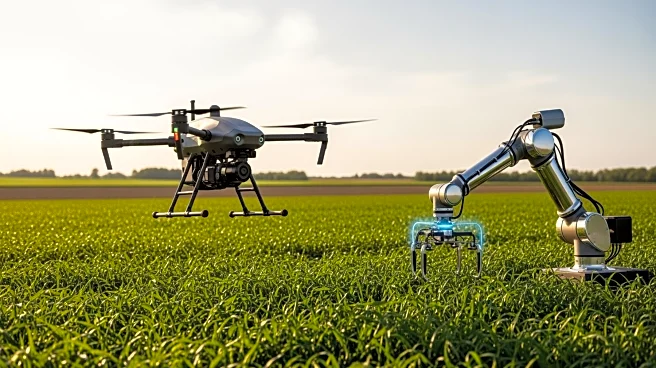
In 2025, the farm robotics sector experienced substantial investment growth, with top fundraises focusing on automation technologies for various agricultural applications. Investors showed interest in companies like Bonsai Robotics, which specializes in orchard automation, and 4AG, which focuses on harvesting technologies. Additionally, investments extended beyond traditional field applications to include areas like oyster farming, as seen with Seascape. The sector is evolving from single-task machines to comprehensive platforms capable of handling multiple tasks across different environments, such as fields, beehives, greenhouses, and oceans. The total funding for farm robotics in 2025 is nearing the $744 million mark set in 2024, with more
deals expected to be finalized soon.
Why It's Important?
The growth in farm robotics investment highlights a shift towards more efficient and sustainable agricultural practices. By reducing reliance on chemical inputs and addressing labor shortages, these technologies can significantly impact the agricultural industry. The move from experimentation to measurable impact suggests that farm robotics are becoming more integrated into mainstream agricultural operations, potentially leading to increased productivity and reduced costs for farmers. This trend could also drive innovation in related sectors, such as food production and environmental sustainability, as robotics technologies become more advanced and widely adopted.
What's Next?
Looking ahead to 2026, the focus will be on transitioning from experimental technologies to those that deliver real, measurable impacts. Reservoir Farms, a new venture in California, aims to bridge the gap between prototypes and production by providing R&D space alongside working specialty crop farms. This approach will help robotics teams validate and scale their technologies in real-world conditions. The emphasis will be on improving harvest labor, non-harvest automation, and precision inputting, areas where economic benefits for growers are already evident. The sector is expected to become more capital-efficient, leveraging open-source infrastructure and edge vision technologies.