




What's Happening?
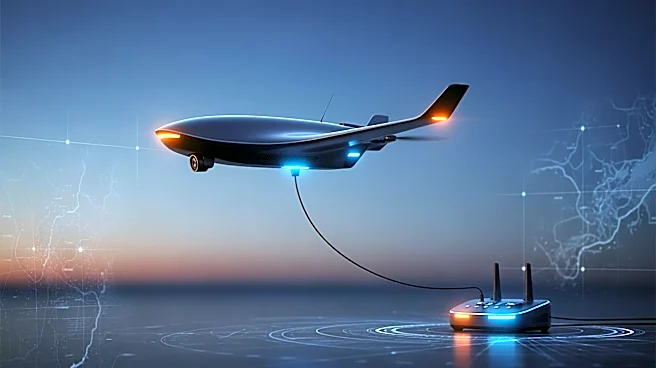
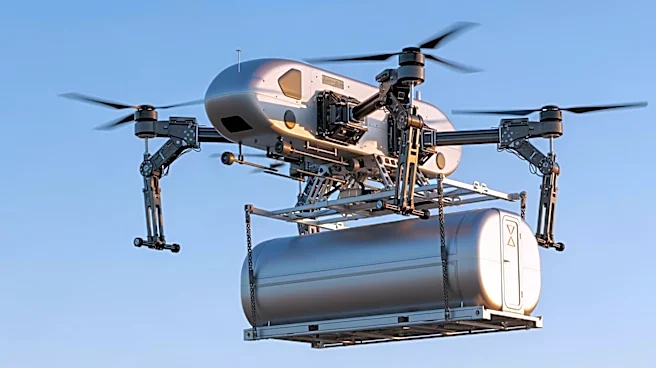
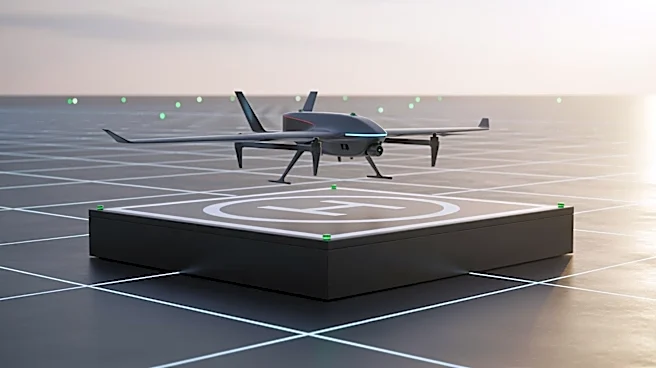
AIR has announced the successful completion of the first flight of its Production AIR Cargo-Heavy Lift UAS, a vertical take-off and landing (VTOL) platform. This unmanned aerial system (UAS) is designed for high-volume mass production and features advanced
motors, an aircraft battery system, and matured avionics. The platform is engineered to execute missions with minimal human intervention, thanks to its enhanced autonomy and flight logic. The development of this UAS involved two years of engineering and operational learning, with hundreds of flights and customer feedback shaping its design. The aircraft is capable of carrying a payload of approximately 550 lbs and has a 70-cubic-foot cargo bay. It is categorized as a Group 4 UAS by the U.S. Department of Defense, making it suitable for military logistics as well as commercial and humanitarian applications.
Why It's Important?
The successful flight of AIR's heavy-lift UAS marks a significant advancement in unmanned logistics, offering a scalable solution for both military and commercial sectors. The aircraft's dual-use architecture allows it to meet the flexible logistics needs of defense operations in challenging environments, while also serving commercial purposes such as mid-mile delivery and maritime resupply. The ability to perform in difficult conditions, such as dust and darkness, enhances its utility in various scenarios. The strong market demand, evidenced by over 25 units already ordered, underscores the growing reliance on autonomous systems for efficient logistics. This development could lead to increased adoption of unmanned systems in logistics, potentially reducing costs and improving delivery times.
What's Next?
Following the successful flight, AIR is likely to focus on scaling production to meet the demand for its heavy-lift UAS. The company may also explore further enhancements to the platform's capabilities, potentially expanding its applications in other sectors. As the UAS gains traction, regulatory bodies might need to address new guidelines for the operation of such systems, especially in civilian airspace. Additionally, competitors in the unmanned logistics market may accelerate their own development efforts to keep pace with AIR's advancements.