


What's Happening?
Kuka, a leading industrial robot maker, has announced its 'Automation 2.0' strategy, which focuses on integrating artificial intelligence with industrial automation systems. This strategy aims to enable more adaptive and autonomous operations, moving
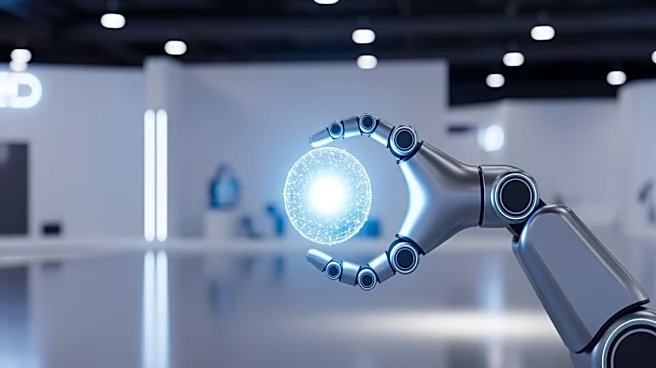
from traditional rule-based automation to intent-driven systems. The approach was presented at the Nvidia GTC event and reflects a shift towards 'physical AI'—systems capable of perceiving, deciding, and acting in real-world environments. Kuka's new software platform, Kuka AMP, is designed to connect hardware, software, and simulation tools into a unified environment, facilitating software-defined automation.
Why It's Important?
Kuka's strategy represents a significant evolution in industrial automation, as AI integration promises to enhance the adaptability and efficiency of robotic systems. This shift could lead to more intelligent and collaborative robots that operate safely alongside humans, potentially transforming manufacturing processes. The move towards 'physical AI' highlights the industry's focus on creating systems that can autonomously handle complex tasks, reducing the need for detailed programming and increasing operational flexibility. Kuka's investment in AI and global expansion efforts underscore the company's commitment to leading this technological transformation.
What's Next?
Kuka plans to continue investing in research and development to support its AI-enabled automation strategy. The company is expanding its software and AI capabilities globally, with new facilities in Silicon Valley and Asia. As Kuka positions itself as a 'physical AI company,' it will need to balance the integration of AI with existing deterministic systems to meet the reliability and cost constraints of manufacturing environments. The success of this strategy will depend on Kuka's ability to deploy AI-driven systems that enhance productivity while maintaining safety and reliability.