








What's Happening?
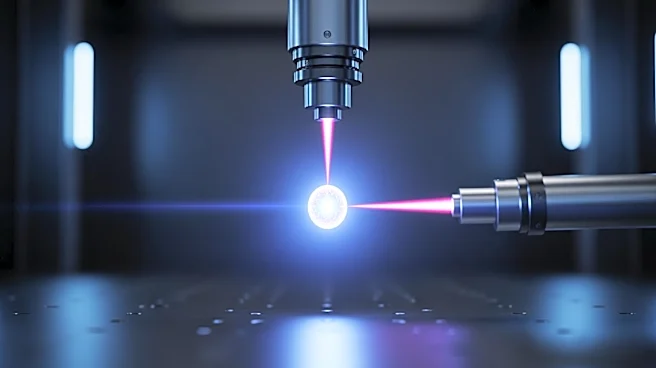
Xcimer Energy has commenced operations of its Phoenix prototype, the largest privately owned laser system globally, aimed at commercializing laser fusion technology. Located in Denver, Colorado, Phoenix utilizes a krypton fluoride excimer laser with Stimulated
Brillouin Scattering to compress laser pulses for fusion. This marks the first step in Xcimer's plan to develop Vulcan, the world's largest laser, and Athena, a commercial fusion power plant. The company has rebuilt industrial capabilities around large-scale excimer lasers, a competence nearly lost post-Cold War, with support from the U.S. Department of Energy.
Why It's Important?
The development of Phoenix by Xcimer Energy signifies a pivotal advancement in the pursuit of commercial fusion energy, which promises a clean and virtually limitless power source. By simplifying and reducing the cost of laser systems, Xcimer aims to make fusion energy economically viable for grid-scale electricity generation. This could revolutionize the energy sector, reducing reliance on fossil fuels and contributing to climate change mitigation. The project also highlights the importance of restoring industrial capabilities in high-energy laser technologies, which are crucial for national security and scientific research.
What's Next?
Xcimer Energy plans to continue its roadmap towards commercial fusion energy with the development of Anvil, Vulcan, and Athena. Anvil is expected to deliver 200 kilojoules on target by 2028, while Vulcan aims for wall-plug breakeven in the early 2030s. Athena, projected for the mid-2030s, will be designed for continuous grid-scale electricity generation. The company is conducting a tour of its Denver facility to showcase its advancements and engage with stakeholders. These developments will likely attract further investment and collaboration in the fusion energy sector.