
What's Happening?
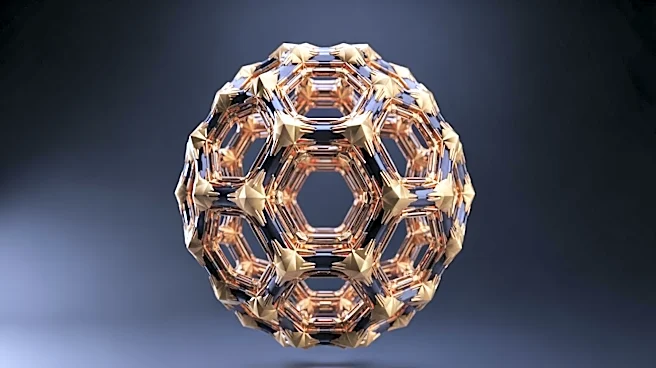
Researchers at Brown University have provided the first experimental evidence of a 'buckyball' molecule composed of 80 boron atoms. This discovery is significant as it introduces a new nanostructure that
could rival the well-known carbon buckyball, Buckminsterfullerene, which has been pivotal in the field of nanotechnology. The boron buckyball was identified using photoelectron spectroscopy, which revealed a highly stable and symmetric structure, contrary to previous theoretical predictions. This finding challenges existing density functional theory (DFT) calculations, which suggested that such a structure would not be stable. The research team, led by Professor Lai-Sheng Wang, aims to further explore the chemical reactivity of this new boron structure to determine its potential applications in various fields.
Why It's Important?
The discovery of the boron buckyball could have significant implications for the field of nanotechnology. Boron, being a neighbor of carbon on the periodic table, may offer unique properties that could surpass those of carbon-based nanostructures. This could lead to advancements in energy technology, medicine, and materials science. The ability to synthesize boron buckyballs in bulk could open new avenues for research and development, potentially leading to more efficient and versatile nanomaterials. The challenge now lies in understanding the stability and reactivity of these structures in ambient conditions, which could pave the way for their practical application.
What's Next?
The next steps involve collaborating with other research labs to investigate the chemical properties of the boron buckyball. Understanding its reactivity and stability in non-vacuum conditions is crucial for determining its potential for large-scale synthesis and application. The research team is optimistic that, similar to the rapid development of borophene, the boron buckyball could soon be produced in bulk, enabling its use in various technological applications. Further research will also focus on refining theoretical models to better predict the properties of boron-based nanostructures.