








What's Happening?
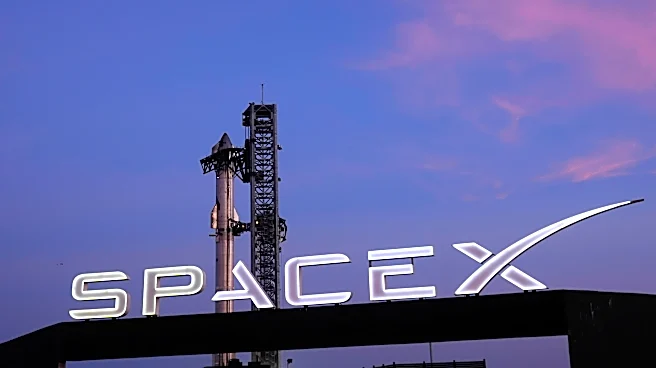
SpaceX has successfully completed the largest initial public offering (IPO) in history, raising $75 billion and achieving a valuation of approximately $1.77 trillion. The company, founded by Elon Musk, sold over 555 million shares at $135 each, marking
a significant milestone for the aerospace sector. The IPO has intensified focus on SpaceX's future infrastructure plans, which include integrating artificial intelligence, satellite communications, and space-based manufacturing. The company aims to develop space-based computing platforms to address power and cooling constraints faced by terrestrial data centers.
Why It's Important?
The successful IPO positions SpaceX as one of the world's most valuable companies, potentially accelerating investment in the space economy. This includes sectors such as launch services, satellite manufacturing, and communications networks. The company's ambitious plans for orbital AI infrastructure could revolutionize industries reliant on controlled manufacturing environments, such as semiconductor production and aerospace systems. The IPO's success also underscores the growing interest and investment in space-based technologies and their potential to transform various sectors.
What's Next?
Following the IPO, SpaceX plans to advance its $55 billion Terafab semiconductor facility in Texas, which recently secured a 35-year tax incentive package. This facility aims to produce advanced chips for both terrestrial and space-based computing infrastructure. The company's focus on integrating AI and space infrastructure is expected to drive further investment and innovation in the space economy. As SpaceX continues to expand its operations, the implications for industries such as aerospace, electronics, and telecommunications are significant.