
What's Happening?
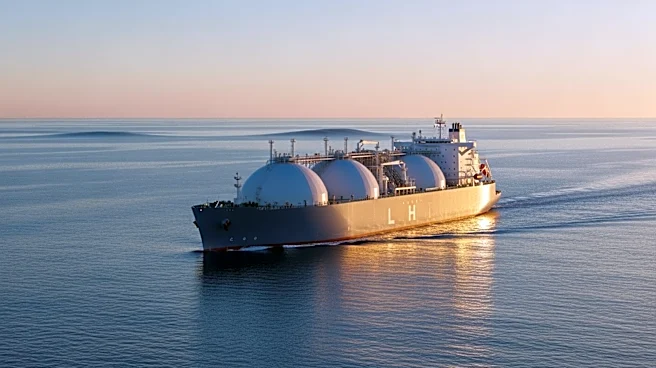
Taiwanese shipping company U-Ming has announced the naming of its first LNG carrier, marking a significant step in its business growth and diversification strategy. The vessel, named Diamond Gas Jade,
was unveiled at a ceremony on May 19 at Samsung Heavy Industries' Geoje Shipyard in South Korea. This new addition to U-Ming's fleet represents the company's entry into the energy transport sector, complementing its existing operations in Very Large Crude Carriers. The Diamond Gas Jade is equipped with the latest energy-saving technologies and a dual-fuel ME-GA propulsion system, allowing it to achieve speeds of up to 19.5 knots. With a capacity of 174,000 cubic meters of LNG, the ship is set to be delivered in August, after which U-Ming plans to launch a joint venture to expand its operations into LNG transport.
Why It's Important?
U-Ming's expansion into LNG transport is a strategic move that aligns with global trends towards cleaner energy sources. As the demand for LNG increases, U-Ming's entry into this market positions it to capitalize on the growing need for energy-efficient and environmentally friendly shipping solutions. This diversification not only strengthens U-Ming's market position but also contributes to the broader industry shift towards sustainable energy transport. The company's investment in LNG carriers and its ongoing commitment to alternative energy sectors, such as offshore wind support, reflect a proactive approach to adapting to changing market demands and regulatory environments. This move could potentially enhance U-Ming's competitiveness and profitability in the long term.
What's Next?
Following the delivery of the Diamond Gas Jade, U-Ming plans to establish a joint venture to further its involvement in LNG transport. This initiative is part of a broader strategy to expand its fleet and operations, with the goal of exceeding 100 vessels and a total deadweight tonnage of over 10 million tons. U-Ming's board has also approved the construction of additional bulk carriers, indicating a continued focus on fleet expansion and diversification. As the company integrates LNG transport into its operations, it may explore further opportunities in international trade and partnerships, potentially leading to increased market share and influence in the global shipping industry.