




What's Happening?
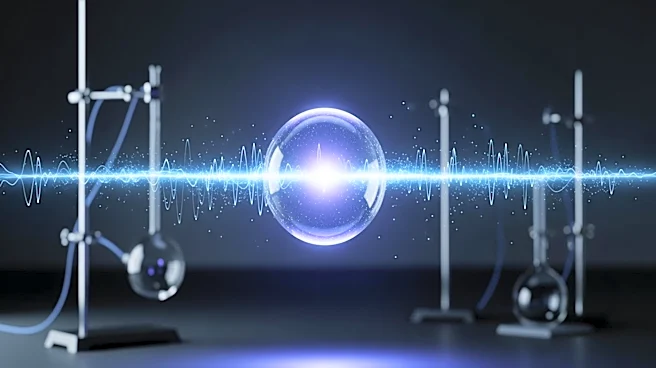
Physicists at Tsinghua University in Beijing have simulated the phenomenon of 'false vacuum decay' using a tabletop experiment with Rydberg atoms. This process, theorized to occur in the universe, involves a metastable state transitioning to a more stable state via
quantum tunneling. The experiment used a ring of Rydberg atoms to mimic the energy states of false and true vacuums, allowing researchers to observe the quantum tunneling process in real-time. The study provides insights into the dynamics of quantum systems and the potential for simulating cosmic events in a controlled laboratory setting.
Why It's Important?
Simulating false vacuum decay in a laboratory setting offers a unique opportunity to study complex quantum phenomena that are otherwise difficult to observe. This research could enhance our understanding of quantum field theory and the stability of the universe. The ability to replicate such processes in a controlled environment may lead to new discoveries in quantum mechanics and cosmology, potentially influencing theories about the universe's structure and evolution.