




What's Happening?
SK Hynix, a South Korean memory-chip giant, has experienced a significant surge in its stock value, rising over 250% this year due to booming demand for artificial intelligence (AI) technologies. This increase has propelled the company's market capitalization
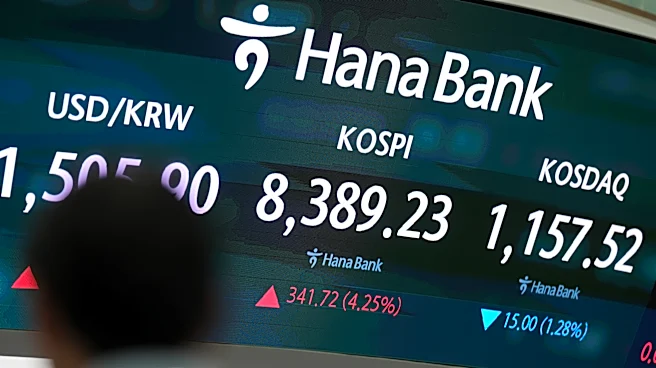
above $1 trillion, as investors flock to companies benefiting from the global demand for high-bandwidth memory chips used in AI servers. Analysts, including Peter Kim from KB Securities, suggest that the fundamentals and valuations of SK Hynix and Samsung Electronics remain strong, despite some strategists expressing concerns about market concentration risks. These risks are heightened by the dominance of Samsung and SK Hynix in South Korea's equity market, accounting for over 40% of the benchmark Kospi index.
Why It's Important?
The surge in SK Hynix's stock highlights the growing influence of AI technology on global markets, particularly in the semiconductor industry. The demand for memory chips, crucial for AI accelerators and servers, is driving significant capital expenditure from major tech companies, projected to reach $725 billion. This trend underscores the strategic importance of companies like SK Hynix in the AI supply chain. However, the concentration of market power in a few companies raises concerns about potential vulnerabilities, such as supply chain disruptions and investment slowdowns in data centers. The ongoing rally in AI-linked stocks could also lead to overvaluation, posing risks to investors.
What's Next?
As the AI-driven demand for memory chips continues, SK Hynix and similar companies are expected to maintain their growth trajectory. However, analysts warn that the semiconductor upcycle could eventually face challenges from overcapacity, which typically ends such cycles. This is not anticipated to occur soon, as capacity expansion is expected to take several years. Investors are advised to remain cautious of potential market corrections and to monitor developments in AI infrastructure spending and global economic conditions that could impact the semiconductor industry.