






What's Happening?
Li Zhenguo, founder of LONGi, has published an article in Nature Sustainability discussing the potential of photovoltaic (PV) technology to enhance global food security. The article outlines two pathways: a PV-driven synthetic starch production from carbon
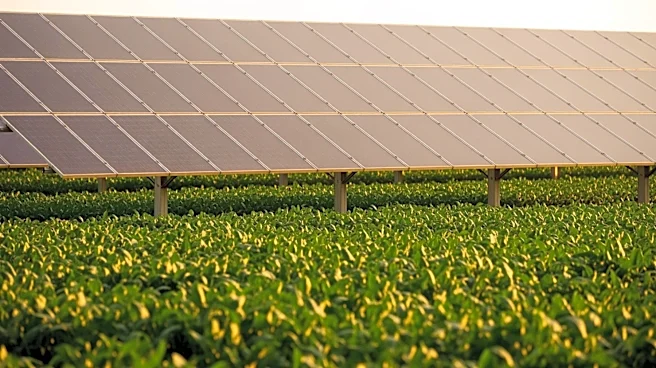
dioxide and an 'energy-water-food' synergistic system. The first pathway involves using PV-generated electricity to produce green hydrogen and synthesize starch, offering higher solar energy efficiency than natural photosynthesis. The second pathway leverages PV systems to improve soil microclimates and reduce irrigation needs, potentially transforming desert areas into arable land. These innovations aim to address food supply challenges exacerbated by climate change.
Why It's Important?
The integration of PV technology into food production systems represents a significant advancement in addressing global food security amidst climate change. By reducing dependency on natural photosynthesis and improving land use efficiency, these technologies could mitigate the impacts of extreme weather on agriculture. This approach not only supports sustainable development but also aligns with global efforts to reduce carbon emissions. The potential to transform deserts into productive farmland could significantly increase food reserves, providing a buffer against food shortages and enhancing resilience in the face of environmental challenges.
What's Next?
Further research is needed to assess the economic viability and environmental impacts of these PV-driven pathways on a large scale. Interdisciplinary studies will be crucial to evaluate the sustainability of water resource utilization and the ecological effects of desert transformation. As these technologies advance, they may attract interest from governments and industries seeking sustainable solutions to food security. The development of policies and frameworks to support the integration of PV technology in agriculture will be essential to realize its full potential.