





What's Happening?
U.S. Treasury yields showed minimal movement on Thursday as investors prepared for key economic data releases that could influence the Federal Reserve's interest rate decisions. The yield on the 10-year Treasury note, a benchmark for government borrowing,
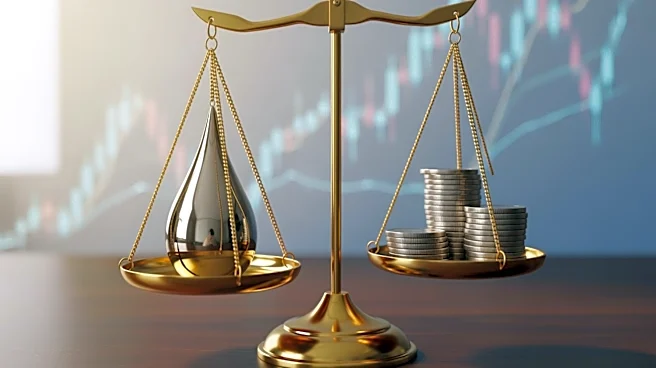
was nearly unchanged at 4.295%. Meanwhile, the 2-year Treasury note yield, which is more sensitive to short-term rate changes, fell slightly to 3.785%. This stability in yields comes as oil prices rallied, with West Texas Intermediate futures rising 5% and Brent crude futures up 4%. The recent ceasefire agreement between the U.S. and Iran initially led to a drop in energy prices, but tensions remain, causing oil prices to climb again. Investors are closely watching the personal consumption expenditures (PCE) price index, the Fed's preferred inflation gauge, which rose 0.4% in February, aligning with expectations. Core PCE, excluding food and energy, also met forecasts. Despite these figures, inflation remains above the Fed's 2% target, prompting discussions about potential rate hikes.
Why It's Important?
The steadiness in U.S. Treasury yields amidst fluctuating oil prices and persistent inflation highlights the complex economic environment facing the Federal Reserve. The Fed's decision-making is crucial as it balances controlling inflation with supporting economic growth. The PCE index's rise indicates ongoing inflationary pressures, which could lead to future rate hikes if the trend continues. This situation affects various stakeholders, including investors, businesses, and consumers, as interest rates influence borrowing costs, investment returns, and consumer spending. The potential for rate cuts, as indicated by market expectations, adds another layer of uncertainty, impacting financial markets and economic planning.
What's Next?
Investors and policymakers will closely monitor upcoming economic data releases, including GDP growth rates and personal income and spending figures, to gauge the economy's health and inflation trajectory. The Federal Reserve's future actions will depend on these indicators, with the possibility of rate hikes if inflation remains above target. Additionally, geopolitical developments, such as the fragile ceasefire with Iran, could further influence energy prices and economic stability. Stakeholders will need to remain agile in response to these evolving conditions, with potential adjustments in investment strategies and economic policies.