
What's Happening?
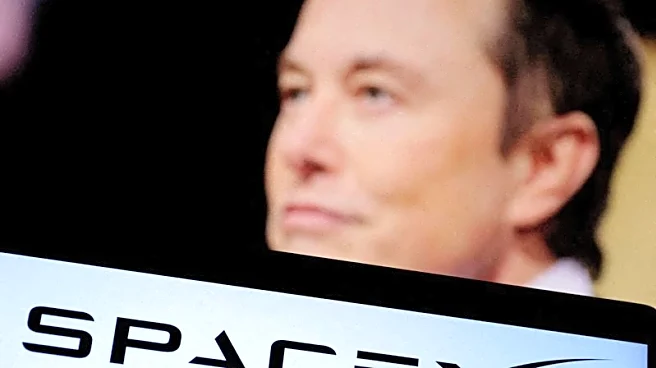
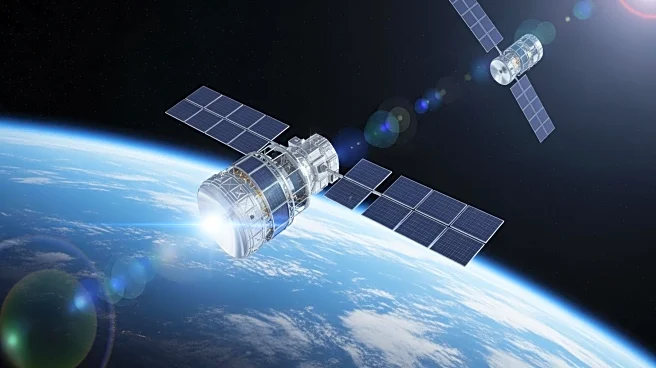
Elon Musk has orchestrated a significant merger between his rocket company, SpaceX, and his artificial intelligence startup, xAI. This merger has resulted in a combined business valued at $1.25 trillion, with SpaceX valued at $1 trillion and xAI at $250 billion. The merger aims to extend 'the light of consciousness to the stars,' as Musk describes it, by integrating AI capabilities with space technology. A key component of this strategy is to move AI datacenters into space, utilizing solar-powered satellites to reduce the energy demands of earth-bound datacenters. This ambitious plan envisions deploying up to a million satellites to create a distributed computing network in orbit. However, the merger raises questions about its feasibility and the impact
on SpaceX's non-Musk shareholders, as well as the technological challenges of maintaining such a system in space.
Why It's Important?
The merger between SpaceX and xAI is significant as it represents a bold step in integrating space technology with artificial intelligence, potentially revolutionizing both industries. For SpaceX, this merger could provide a new revenue stream and enhance its technological capabilities. For xAI, the merger offers financial stability and access to SpaceX's resources, which is crucial as it competes with tech giants like Meta, Amazon, and Google. The merger also highlights Musk's vision of creating a vertically integrated innovation engine that could lead to advancements in AI and space exploration. However, the merger's success depends on overcoming technical challenges and convincing investors of its long-term viability.
What's Next?
The next steps for the merged entity include preparing for a stock market flotation expected in June, coinciding with Musk's birthday and a planetary alignment. This public offering will be a critical test of investor confidence in the merger's potential. Additionally, the company will need to address the technical challenges of deploying and maintaining a vast network of satellites to support its AI ambitions. Stakeholders, including SpaceX's non-Musk shareholders, will be closely monitoring the merger's impact on the company's financial health and strategic direction. The merger could also prompt reactions from competitors in the AI and space sectors, potentially leading to further consolidation or innovation in these industries.
Beyond the Headlines
Beyond the immediate financial and technological implications, the merger raises broader questions about the future of AI and space exploration. The concept of space-based datacenters challenges traditional notions of data infrastructure and could lead to new regulatory and ethical considerations. The merger also underscores the growing intersection of technology and space, with potential implications for global communications, data privacy, and international cooperation in space. As Musk's vision unfolds, it may influence public policy and industry standards, shaping the future landscape of both AI and space exploration.