

What's Happening?
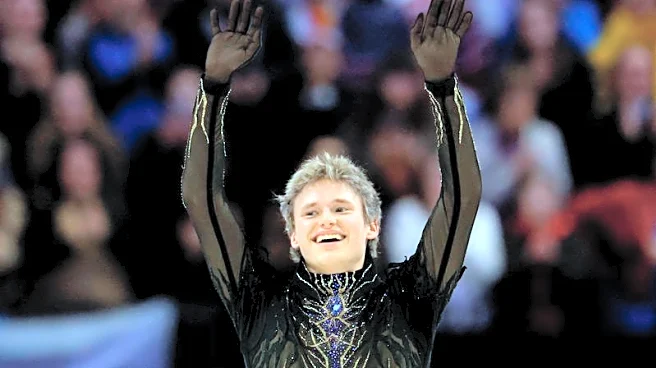
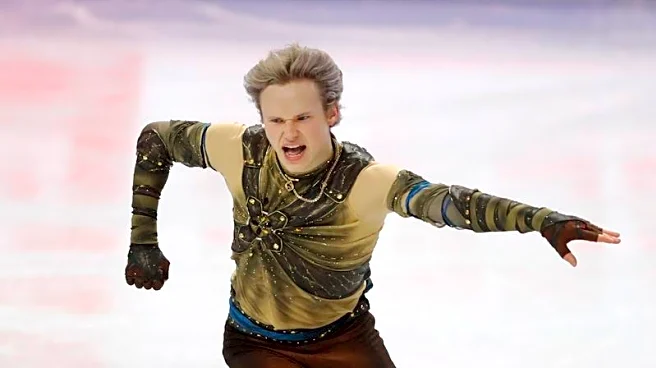
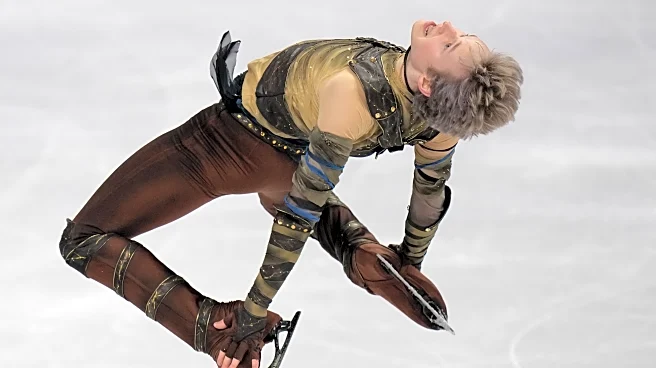
Ilia Malinin has won his third consecutive world figure skating title at the World Figure Skating Championships in Prague. This victory comes just six weeks after a disappointing performance at the Olympics, where he was a favorite for the gold medal
but failed to reach the podium. Known as the 'quad god' for his ability to execute quadruple jumps, Malinin delivered a strong performance, landing five quadruple jumps and a backflip, although he did not attempt his signature quad axel. He scored 218.11 in the free skate, achieving a total score of 329.40, which placed him well ahead of Japan's Yuma Kagiyama, who took silver with 306.67, and Shun Sato, also from Japan, who won bronze with 288.54. Malinin's victory marks him as the first skater to win three consecutive men's world titles since Nathan Chen, who achieved this feat in 2018, 2019, and 2021.
Why It's Important?
Malinin's triumph is significant as it demonstrates his resilience and ability to recover from the psychological and physical challenges faced during the Olympics. His success not only reinforces his status as a leading figure in men's figure skating but also highlights the competitive nature of the sport, where athletes must consistently perform at their best to maintain their standing. This victory could enhance Malinin's marketability and open up further opportunities for endorsements and media appearances, which are common for athletes who achieve such milestones. Additionally, his performance sets a high standard for upcoming skaters and contributes to the ongoing narrative of American dominance in men's figure skating, following in the footsteps of Nathan Chen.
What's Next?
Looking ahead, Malinin may focus on preparing for future competitions, including the next Olympic cycle, where he will aim to secure the gold medal that eluded him this year. His continued success could inspire a new generation of skaters and potentially influence the strategies and training methods employed by coaches and athletes worldwide. The figure skating community will likely watch his career with interest, anticipating further innovations in his performances, particularly with his quad axel, which remains a rare and challenging element in the sport.